
Contextual RAG Agents & Multi-Agent Systems
Contextual RAG Agents & Multi-Agent Systems
AI that actually knows your business—trained on your documents, connected to your systems, and accurate enough to trust.
Generic AI assistants hallucinate because they don't know your products, policies, or processes. They give plausible-sounding answers that are completely wrong for your specific context. Your team wastes time fact-checking AI outputs, and customers get frustrated with responses that don't apply to their situation.
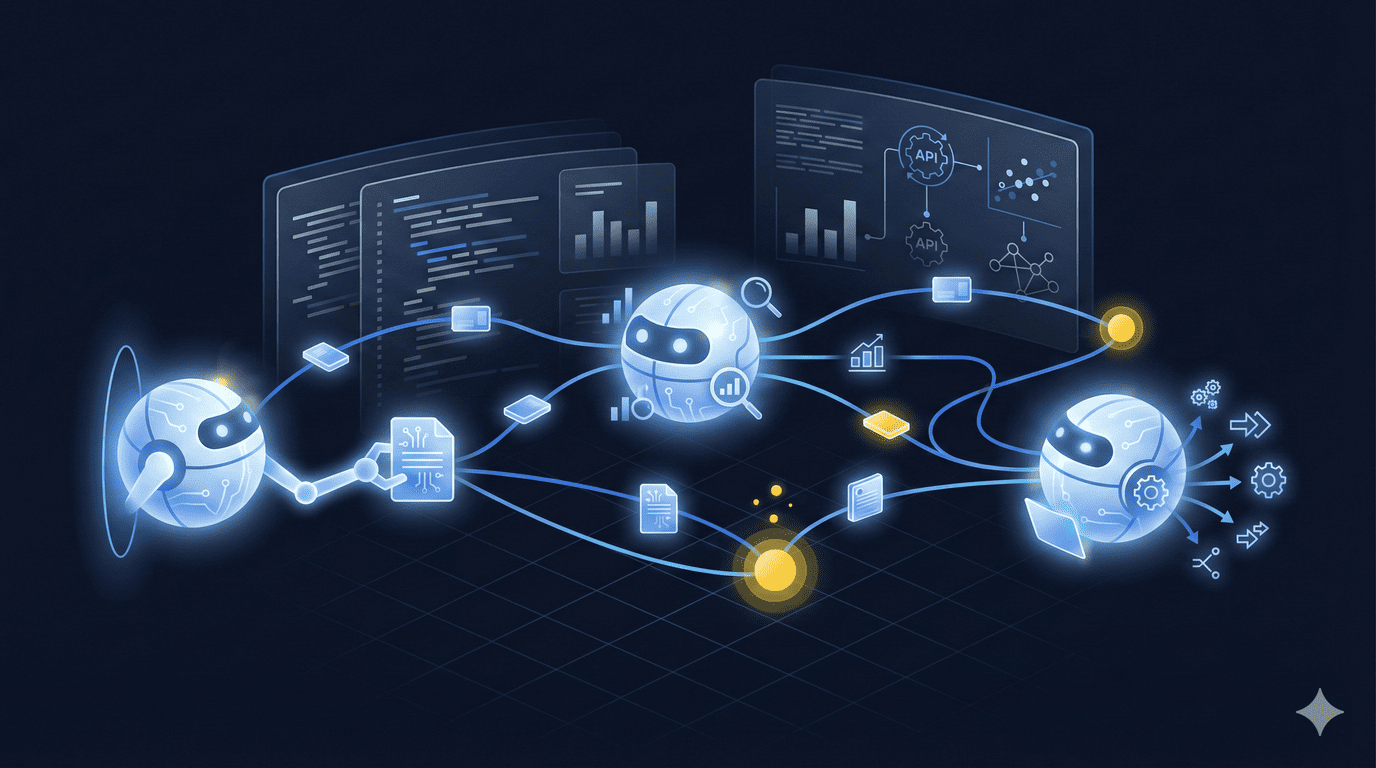
LoomReach builds Retrieval-Augmented Generation (RAG) agents grounded in your actual business knowledge. We connect AI to your documentation, databases, and systems—creating intelligent assistants that retrieve real information before responding. For complex operations, we deploy multi-agent systems where specialized AI agents collaborate to handle sophisticated workflows no single model can manage.
- Reduce AI hallucination rates to under 5% by grounding responses in your verified knowledge base
- Automate 70-90% of knowledge retrieval tasks—policy lookups, document searches, data queries
- Deploy in 2-4 weeks with full integration into your existing document and data systems
- Scale expert knowledge across your organization without scaling your expert headcount
Who This Service Is For
This service is built for organizations where accurate, context-specific information is critical—where generic AI responses aren't just unhelpful but potentially harmful. If your team spends hours searching documents, your experts are bottlenecks for routine questions, or you've tried AI solutions that couldn't handle your specific domain, RAG agents solve those problems.
We work best with businesses that have accumulated significant knowledge assets (documentation, procedures, historical data) but struggle to make that knowledge accessible and actionable. The value compounds with complexity—the more specialized your domain and the larger your knowledge base, the more transformative RAG becomes.
- Professional services firms (legal, accounting, consulting) needing instant access to case law, regulations, and client history
- Healthcare organizations requiring accurate clinical guidelines, drug interactions, and protocol lookups
- Financial services companies navigating complex regulatory requirements and product documentation
- Manufacturing and engineering firms with extensive technical documentation and specifications
- Technology companies with large codebases, API documentation, and technical knowledge bases
- Government and public sector managing vast policy libraries and citizen service information
- Education and training organizations scaling expert instruction through AI tutoring
- Enterprise support teams needing to navigate complex product ecosystems accurately
The Reality Before Contextual AI Agents
Organizations invest heavily in creating knowledge—policies, procedures, documentation, training materials—then struggle to access it when needed. These pain points are universal across knowledge-intensive operations, and generic AI solutions often make things worse.
- Employees spend 20-30% of their time searching for information that exists somewhere in your systems
- Your subject matter experts are constantly interrupted for questions they've answered hundreds of times
- Generic AI assistants give confidently wrong answers because they don't know your specific policies and products
- New employees take months to become productive because institutional knowledge isn't accessible
- Customer support agents give inconsistent answers because they can't quickly find the right documentation
- Compliance risks increase when employees make decisions based on outdated or incorrect information
- You've invested in knowledge management systems that nobody uses because they're too slow or return irrelevant results
A Typical Day Before LoomReach
Scenario 1: The Expert Bottleneck
Your senior compliance officer gets 40 questions per week from the team—most are routine policy clarifications that could be answered from existing documentation. But searching the policy library takes 15 minutes, and people would rather just ask her. She spends 10 hours weekly answering questions instead of doing strategic work. Meanwhile, decisions wait in queue because she's the only person who "really knows" the policies.
Scenario 2: The Costly Hallucination
Your customer service team deployed a generic AI chatbot to handle routine inquiries. It seemed to work—until a customer received incorrect refund policy information and escalated. The AI had hallucinated a policy that didn't exist. You discovered it had been giving subtly wrong answers for weeks. Trust in AI tools collapsed, and you're back to manual responses while wondering if AI can ever be reliable.
The LoomReach Approach: AI Grounded in Your Reality
We build AI systems that don't guess—they retrieve. Before generating any response, our RAG agents search your knowledge base, find relevant information, and ground their answers in verified sources. For complex operations requiring multiple skills, we deploy multi-agent architectures where specialized agents collaborate, each handling what they do best.
- Knowledge Base Ingestion processes your documents, databases, wikis, and unstructured data into a searchable vector database optimized for semantic retrieval
- Contextual Retrieval finds the most relevant information for each query using advanced embedding models that understand meaning, not just keywords
- Grounded Response Generation produces answers that cite specific sources, enabling verification and building trust
- Multi-Agent Orchestration coordinates specialized agents for complex workflows—research, analysis, drafting, review—each with their own tools and expertise
- System Integration connects agents to your CRM, ERP, ticketing systems, and databases for real-time data access
- Continuous Learning updates the knowledge base as documents change, ensuring agents always access current information
- Confidence Scoring indicates when agents are uncertain, triggering human review rather than confident hallucination
- Audit Trails log every retrieval and generation step for compliance, debugging, and continuous improvement
Before vs After: The Knowledge Access Transformation
The shift from generic AI to contextual RAG agents changes how your organization accesses and uses its accumulated knowledge. Information that was locked in documents becomes instantly actionable.
| Before LoomReach | After LoomReach |
|---|---|
| Time to find policy information: 10-30 minutes | Time to find policy information: Under 30 seconds |
| AI hallucination rate: 15-40% on domain questions | AI hallucination rate: Under 5% with source citations |
| Expert time on routine questions: 10-15 hours/week | Expert time on routine questions: 1-2 hours/week (edge cases only) |
| New employee ramp-up: 3-6 months to productivity | New employee ramp-up: 2-4 weeks with AI-assisted learning |
| Knowledge accessibility: Depends on who you know to ask | Knowledge accessibility: Self-service for all documented information |
| Document utilization: 20% of knowledge base actively used | Document utilization: 80%+ of knowledge base retrievable |
| Cross-department knowledge sharing: Manual, inconsistent | Cross-department knowledge sharing: Automatic, unified |
| Compliance verification: Manual document review | Compliance verification: Instant policy lookup with audit trail |
How We Build Your RAG Agent System: A 6-Step Process
Step 1: Knowledge Audit and Architecture Design (Week 1)
What we do: We map your knowledge landscape—where information lives, how it's structured, how people currently access it, and where the gaps and pain points are. We design the technical architecture based on your specific requirements and integration needs.
What you receive: Knowledge Architecture Document detailing data sources, retrieval strategy, agent design, and integration specifications.
Time investment from you: Two 90-minute discovery sessions with stakeholders; access to documentation systems and sample queries.
Step 2: Data Ingestion and Processing (Week 1-2)
What we do: We connect to your document repositories, databases, and knowledge systems. We process documents into optimized embeddings, handle various formats (PDF, Word, HTML, databases), and build the vector search infrastructure.
What you receive: Fully indexed knowledge base with semantic search capability. Data processing documentation and update procedures.
Time investment from you: Provide access to data sources; identify sensitive content requiring special handling.
Step 3: Agent Development and Training (Week 2-3)
What we do: We develop the RAG agents with appropriate retrieval strategies, prompt engineering, and response formatting. For multi-agent systems, we design agent roles, communication protocols, and orchestration logic.
What you receive: Functional RAG agent(s) ready for testing, with documented capabilities, limitations, and optimal use cases.
Time investment from you: Provide sample queries and expected answers; participate in iterative testing and feedback.
Step 4: Integration and Interface Development (Week 3-4)
What we do: We integrate agents with your existing systems—Slack, Teams, web interfaces, CRM, ticketing systems. We build user interfaces appropriate for your use cases and configure authentication and access controls.
What you receive: Integrated AI assistants accessible through your existing workflows. User documentation and training materials.
Time investment from you: Provide API access and credentials; define user roles and permissions.
Step 5: Testing, Validation, and Launch (Week 4)
What we do: We conduct comprehensive testing with real queries, validate accuracy against known answers, test edge cases and failure modes, and launch to initial user group with close monitoring.
What you receive: Production-ready system with accuracy benchmarks documented. Pilot user group actively using the system with support.
Time investment from you: Coordinate pilot user group; participate in validation testing; approve production launch.
Step 6: Optimization and Scaling (Ongoing)
What we do: We monitor performance metrics, analyze failed queries, update knowledge bases as documents change, and continuously improve retrieval accuracy and response quality.
What you receive: Monthly Performance Report with accuracy metrics, usage analytics, improvement recommendations. Continuous knowledge base updates and system optimization.
Time investment from you: Bi-weekly review call (30 minutes); notify us of major documentation updates.
Features That Deliver Enterprise-Grade AI
Semantic Search with Source Citation
Every response includes the exact sources used, with page numbers or section references for verification. What this means for trust: Users can verify AI answers instantly. Compliance teams have audit trails. Nobody has to trust AI blindly—they can check.
Multi-Document Reasoning
Agents synthesize information across multiple documents to answer complex questions that require combining knowledge from different sources. What this means for insight: Get answers that previously required an expert to manually connect information across your knowledge base.
Real-Time Data Integration
Beyond static documents, agents connect to live databases, CRM systems, and APIs to incorporate current data into responses. What this means for accuracy: Answers reflect today's reality—current inventory, latest customer data, most recent transactions—not stale document snapshots.
Confidence Scoring and Escalation
When the agent isn't confident—no relevant documents found, conflicting information, ambiguous query—it says so and can escalate to humans rather than guessing. What this means for reliability: Eliminate confident-but-wrong responses. The system knows what it doesn't know.
Multi-Agent Workflows
Complex tasks are broken down among specialized agents—a research agent gathers information, an analysis agent interprets it, a drafting agent creates outputs, a review agent checks quality. What this means for capability: Handle sophisticated workflows that exceed what any single AI model can do reliably.
Conversational Memory
Agents maintain context across conversation turns, understanding follow-up questions and building on previous exchanges. What this means for usability: Natural, productive conversations rather than starting fresh with each question. Users can refine and drill down iteratively.
Access Control and Permissions
Agents respect document-level permissions, only retrieving information users are authorized to access. What this means for security: Deploy AI across your organization without exposing sensitive information to unauthorized users. Information security policies are enforced automatically.
Automatic Knowledge Base Updates
When documents change, the system automatically reprocesses and updates embeddings, ensuring agents always access current information. What this means for maintenance: No manual re-indexing or stale information problems. Your AI stays current as your documentation evolves.
Custom Tool Integration
Agents can use tools beyond retrieval—calculations, API calls, data transformations, external lookups—orchestrated as part of response generation. What this means for capability: Move beyond Q&A to agents that take actions, not just provide information.
Analytics and Feedback Loop
Comprehensive logging of queries, retrievals, responses, and user feedback enables continuous improvement and gap identification. What this means for optimization: Identify missing documentation, frequently asked questions, and accuracy issues. Improve the system based on real usage data.
Integrations and Compatibility
Our RAG systems connect to your existing knowledge repositories and work within your current workflows. We don't require you to move data or change systems—we build on what you have.
Document Repositories
SharePoint, Google Drive, Confluence, Notion, Dropbox, Box, and custom document management systems.
Databases and Data Warehouses
PostgreSQL, MySQL, MongoDB, Snowflake, BigQuery, SQL Server, and custom databases via API.
Communication Platforms
Slack, Microsoft Teams, email integration, and custom chat interfaces for agent access.
Business Applications
Salesforce, HubSpot, Zendesk, ServiceNow, SAP, and ERP systems for real-time data integration.
Development Environments
GitHub, GitLab, Jira, and code documentation for technical knowledge bases.
Custom APIs
Any system with REST or GraphQL API can be connected for data retrieval or action execution.
Security standards: All integrations use encrypted connections, respect existing access controls, and can be deployed in your cloud environment or private infrastructure. We comply with SOC 2, GDPR, and industry-specific requirements as needed.
Frequently Asked Questions
How does pricing work for RAG and multi-agent systems?
Pricing depends on knowledge base size, complexity of retrieval requirements, number of integrations, and expected query volume. Typical projects range from £15,000-50,000 for initial development (2-4 weeks) plus ongoing costs for hosting, maintenance, and continuous improvement (typically £1,500-5,000/month depending on scale). Enterprise multi-agent systems with complex orchestration are priced based on detailed scoping.
How large can the knowledge base be?
We've deployed systems ranging from thousands to millions of documents. Vector databases scale efficiently, and we optimize chunking and retrieval strategies for large corpora. The main constraint is update frequency for very large, rapidly changing knowledge bases—we'll advise on the right architecture during discovery.
How do you handle sensitive or confidential information?
Security is architected from the start. Options include: deploying in your private cloud/on-premises, encrypting data at rest and in transit, implementing document-level access controls, excluding sensitive documents from indexing, and logging all access for audit. We comply with relevant regulations (GDPR, HIPAA, SOC 2) and can sign appropriate agreements.
What if the knowledge base has conflicting information?
The system can be configured to handle conflicts based on your requirements: prefer newer documents, flag conflicts for user review, apply source authority hierarchies, or synthesize with explicit acknowledgment of differences. During development, we identify and resolve obvious conflicts in your documentation.
How do you measure and ensure accuracy?
We establish accuracy benchmarks during development using test queries with known correct answers. Ongoing monitoring tracks retrieval relevance scores, response quality ratings from users, and flagged issues. We target >95% accuracy on factual retrieval and continuously improve based on failure analysis.
Can agents take actions, or only provide information?
Both. Agents can be configured with tool-use capabilities—updating records, triggering workflows, making API calls, generating documents. Multi-agent systems can orchestrate complex action sequences with appropriate approval gates. We design automation scope based on your risk tolerance and compliance requirements.
What happens when the AI can't find an answer?
The system acknowledges uncertainty rather than guessing. Configurable responses include: stating no relevant information was found, suggesting alternative queries, escalating to a human expert queue, or identifying gaps in the knowledge base for documentation improvement.
Stop Letting Knowledge Stay Locked in Documents
Your organization has spent years accumulating expertise—in documentation, policies, case histories, technical specifications. That knowledge is your competitive advantage. But if people can't access it when they need it, it might as well not exist.
Generic AI doesn't know your business and can't be trusted with domain-specific questions. RAG agents change that equation. They ground every response in your verified knowledge, cite their sources, and get smarter as your documentation improves. Your institutional knowledge becomes instantly accessible to everyone who needs it.
LoomReach builds the complete system: knowledge ingestion, semantic retrieval, intelligent agents, system integrations, and ongoing optimization. You get AI that actually knows your business—accurate enough to trust, fast enough to transform how your team works.
If you want to make your organization's knowledge instantly accessible and reduce expert bottlenecks by 70% or more in the next 90 days, let's design your RAG system.
We'll analyze your knowledge landscape, identify the highest-impact use cases, and show you exactly how a RAG system would work in your environment—with realistic timelines and expected results.
