Introduction
The world of search is undergoing its biggest revolution since the birth of Google. AI is no longer a futuristic concept; it's here, and it’s reshaping how your customers find information. You're no longer just optimizing for a list of blue links. You're now competing for visibility within AI-powered answer engines and conversational chatbots like ChatGPT. This article is your guide to navigating this new dual-front for digital visibility. We'll break down exactly what has changed and provide you with a clear, actionable playbook to help you rank in both traditional search engines and the new world of AI-driven answers in 2025 and beyond.
The New Battlefield: Google SGE and AI Engine Optimization (AEO)
For years, Search Engine Optimization (SEO) was a relatively straightforward, if complex, discipline. Today, we need to talk about two acronyms: SGE and AEO. Google's Search Generative Experience (SGE) integrates AI-powered answers directly into the search results page, creating a conversational, summarized response to user queries. This often appears above the traditional number one spot, pulling information from multiple sources.
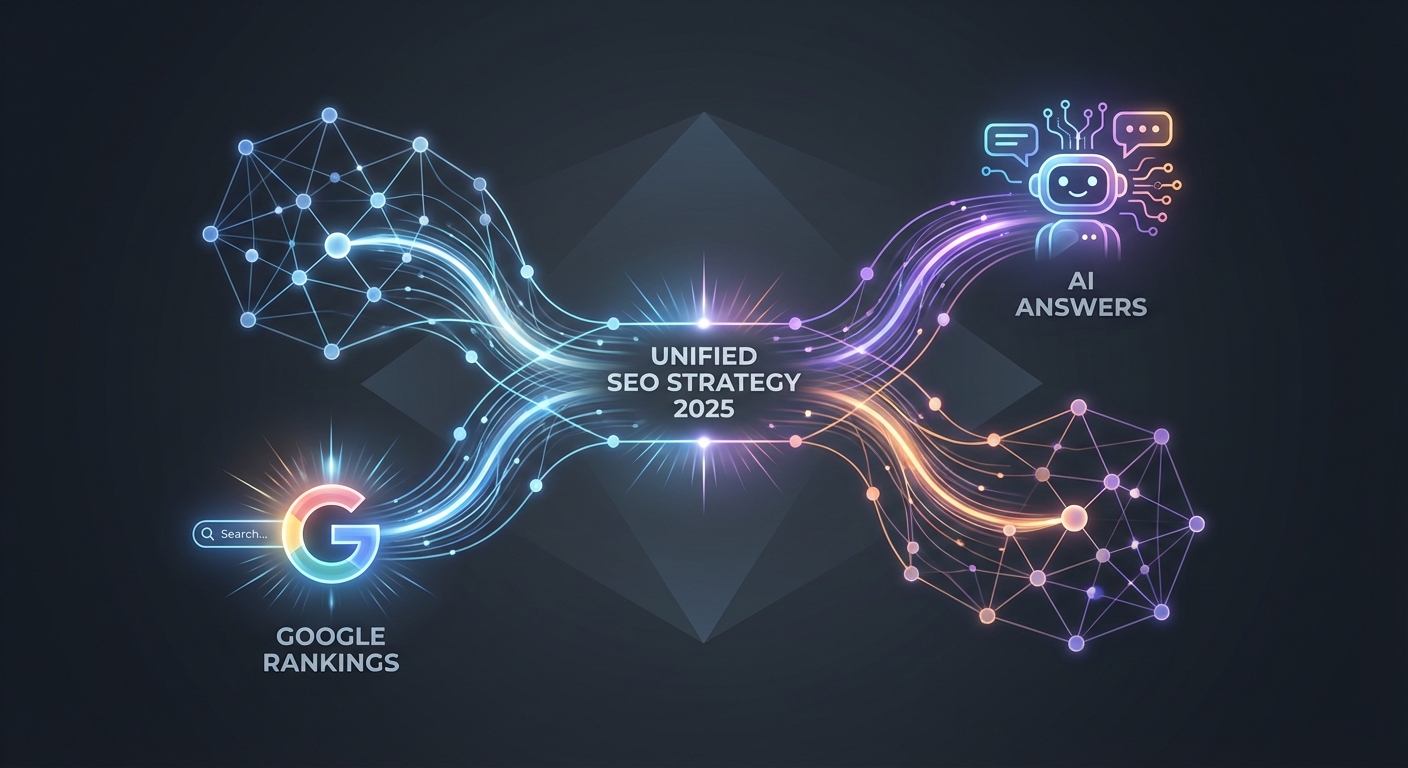
This gives rise to a new discipline: AI Engine Optimization (AEO). AEO is the practice of optimizing your content to be found, understood, and cited by AI models, including both Google's SGE and standalone platforms like ChatGPT. While SEO focuses on ranking your webpage, AEO focuses on making your information the basis for an AI-generated answer. In 2025, a comprehensive strategy requires mastering both.
How AI Redefines Search Intent
AI has fundamentally changed our understanding of search intent. Traditional SEO focused on matching keywords. If a user typed "best running shoes," you made sure your page had that exact phrase. AI, however, understands context, nuance, and conversational language. A user might now ask their phone, "What are the best running shoes for a beginner with flat feet who runs on pavement three times a week?"
AI doesn't just look for keywords; it seeks comprehensive, authoritative answers. It synthesizes information to fulfill the user's true need, not just match their words. This means your content must move beyond simple keyword targeting. It needs to answer questions thoroughly, address follow-up questions proactively, and be structured in a way that an AI can easily parse and understand. Think less about strings of words and more about becoming a definitive resource on a topic.
Your Foundation: Mastering Core SEO for the AI Era
Before you can win in the AI era, you must have your foundational SEO in pristine condition. In fact, the principles of good SEO are more important than ever, as AI systems like Google's rely on these signals to identify high-quality, trustworthy sources. Neglecting them is like building a skyscraper on a foundation of sand.
- Technical SEO: A clean, fast, and secure site is non-negotiable. AI crawlers, just like traditional ones, favor sites that are easy to navigate and index. Ensure your site has a logical structure, a clean XML sitemap, and is mobile-friendly. Site speed is paramount—AI won't wait for a slow-loading page to find an answer.
- E-E-A-T: Google's quality guidelines—Experience, Expertise, Authoritativeness, and Trustworthiness—are the bedrock of SGE. AI is specifically programmed to look for content that demonstrates real, first-hand experience and proven expertise. You must create content that showcases your authority through author bios, case studies, original data, and clear sourcing.
- High-Quality Backlinks: Backlinks remain a powerful vote of confidence. In the AI era, links from reputable, topically relevant sites signal to AI that your content is trusted by other experts, making it a more reliable source for generating answers.
How to Rank in Google’s SGE: Your New Playbook
Appearing in SGE's AI-powered snapshots is the new page one. These snapshots directly answer user queries, often eliminating the need to click on any links. Getting your content featured here is crucial. Here’s how:
- Answer Questions Directly: Structure your content using a question-and-answer format. Use headings (H2s, H3s) that are literal questions your audience might ask. Begin the section with a direct, concise answer before elaborating.
- Use Structured Data (Schema Markup): Schema is code that helps search engines understand the context of your content. Implementing FAQ schema, review schema, and 'HowTo' schema gives Google's AI the structured information it loves, making it easier to pull your content into an SGE result.
- Aim for 'Perspectives': Google is incorporating a 'Perspectives' filter that highlights content from forums, social media, and blogs with first-hand experience. Encourage user-generated content, host discussions on your site, and ensure your blog posts are written with a clear, personal voice to tap into this.
- Embrace Statistics and Citable Facts: AI models are designed to provide factual, data-driven answers. A 2024 report from HubSpot noted that articles with specific data points are 56% more likely to be used as a source for AI-generated summaries. Include recent statistics and cite your sources clearly.
Winning in ChatGPT: How to Become a Cited Source
While Google's SGE is tied to live search, platforms like ChatGPT and others rely on their training data and, increasingly, live web browsing to answer questions. Becoming a go-to source for these AIs can drive significant brand awareness and referral traffic.
- Create Comprehensive, 'Ultimate Guide' Content: AI looks for the most complete resource on a topic. Instead of a short blog post, create a 2,000+ word pillar page that covers a subject from every angle. Use clear headings, lists, and tables to structure the information for easy processing.
- Build a Strong Digital Presence: AIs assess authority not just from one page, but from your entire digital footprint. A strong presence on reputable sites like Wikipedia, industry publications, and established directories reinforces your brand's credibility, making your domain a more trusted source.
- Develop Original Research and Data: The single best way to become a cited source is to be the primary source. Conduct your own industry surveys, publish unique case studies, and create proprietary data. When AI models look for verifiable facts, they will be forced to cite you, as the information originates from your site.
Practical AI Tools for Your 2025 SEO Strategy
Leveraging AI isn't just a defensive move; it's a powerful way to make your SEO efforts more efficient and effective. Here are some tools leading the charge:
- For Content & Keyword Strategy: Tools like Semrush and Ahrefs now incorporate AI to help you discover conversational queries and identify 'semantic gaps' in your content. SurferSEO or MarketMuse can analyze top-ranking pages and provide AI-driven recommendations to make your content more comprehensive.
- For Content Creation & Optimization: While you should never rely solely on AI to write your content, platforms like Jasper or Copy.ai can help you overcome writer's block, generate outlines, and rephrase sentences for clarity. The key is to use them as an assistant, with a human expert always guiding, editing, and adding unique insights.
- For Technical SEO: Tools are emerging that use AI to analyze log files, identifying crawling issues and user behavior patterns that would be nearly impossible for a human to spot. This allows you to optimize your site's technical health with unprecedented precision.
Conclusion: Your Two-Front Strategy for Success
Adapting to the AI era of SEO doesn't mean abandoning everything that has worked for the past decade. It means building upon that solid foundation with a new, two-front strategy. You must continue to create the high-quality, technically sound, and authoritative content that Google's core algorithm rewards. Simultaneously, you must optimize that content to be the definitive answer for the conversational, intent-driven queries that power SGE and AI chatbots. By focusing on E-E-A-T, structuring your content to answer questions directly, and creating comprehensive resources, you position yourself to not only survive but thrive. You will not only rank in Google but also become the trusted source that powers the AI answers of tomorrow. Start your journey into SEO in the AI Era: How to Rank in Google AND ChatGPT in 2025 today.
Ready to future-proof your SEO strategy? Download our free 'AI SEO Checklist' to ensure your business is prepared for the next generation of search.