Introduction
Imagine an AI assistant that doesn't just respond to text commands but actually sees your product images, hears customer voice concerns, and understands the complete context of every interaction. That's not science fiction—it's the reality of multimodal AI assistants transforming business operations in 2025.
For marketing directors and business owners, this technology represents a quantum leap beyond traditional chatbots. While conventional AI tools operate in isolated channels, multimodal AI assistants can see, hear, and understand complete context across multiple data streams simultaneously. This article will show you exactly how these intelligent systems work, why they matter for your business, and how to implement them effectively to enhance customer experiences and operational efficiency.
Whether you're considering upgrading your customer service platform or exploring innovative marketing automation, understanding multimodal AI assistants is essential for staying competitive in today's technology-driven marketplace.
What Are Multimodal AI Assistants?
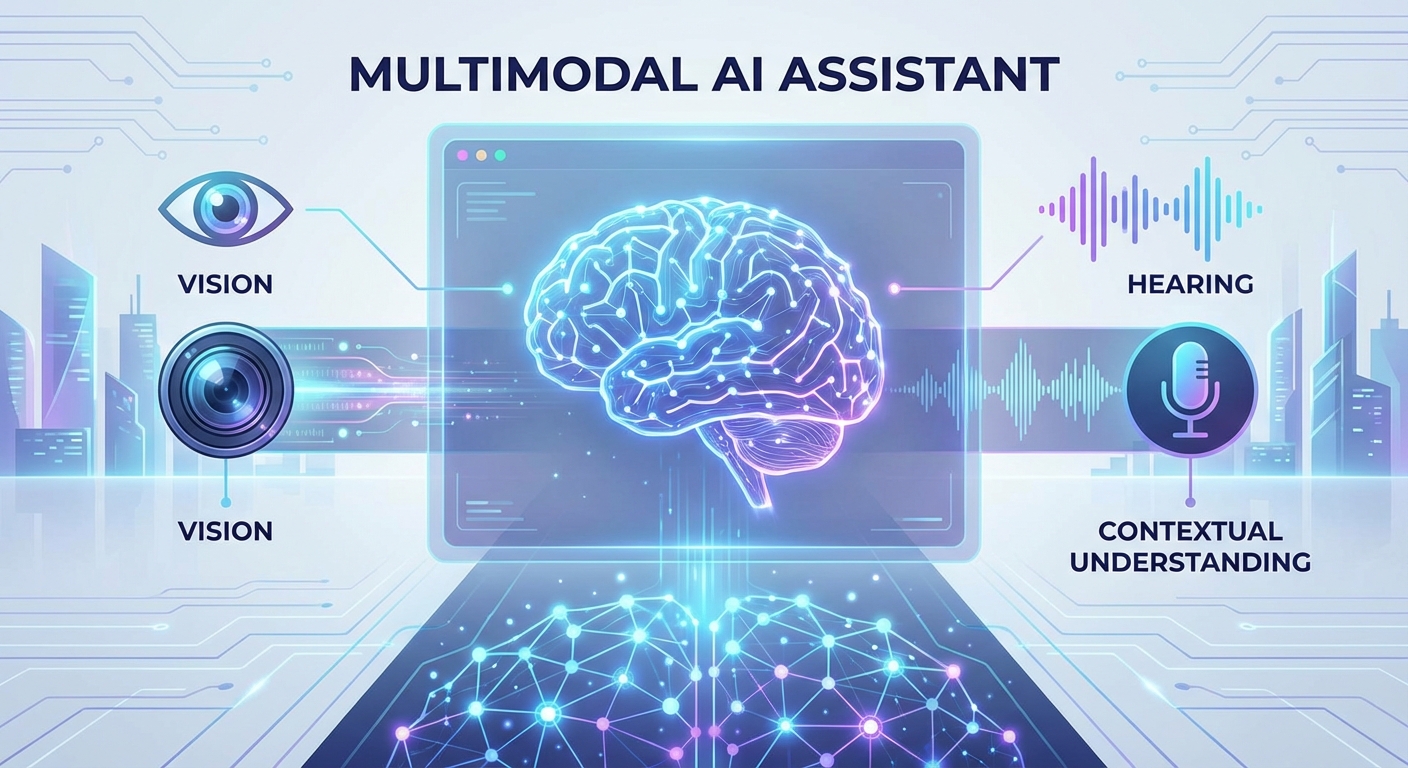
Multimodal AI assistants are advanced artificial intelligence systems that process and understand multiple types of input simultaneously—including text, images, audio, video, and even sensor data. Unlike traditional single-mode AI that only handles one input type, these sophisticated systems integrate information from various sources to create comprehensive understanding.
Think of it this way: a customer service chatbot that only reads text is like having a team member who can only communicate through written notes. A multimodal AI assistant, however, is like having a fully capable employee who can read emails, view product photos, listen to voice messages, and understand the complete situation before responding.
According to Gartner's 2024 research, organizations implementing multimodal AI solutions experienced a 47% improvement in customer satisfaction scores compared to those using traditional single-channel AI tools. This dramatic difference stems from the technology's ability to understand nuanced context that single-mode systems simply miss.
The technology combines computer vision, natural language processing, speech recognition, and contextual reasoning into one unified intelligence platform. This integration allows businesses to automate complex tasks that previously required human judgment and multi-sensory perception.
How Multimodal AI Sees: Visual Intelligence in Action
The visual capabilities of multimodal AI assistants extend far beyond simple image recognition. These systems can analyze product photos, interpret charts and graphs, understand visual brand elements, and even assess emotional cues from customer-submitted images.
For e-commerce businesses, this creates revolutionary possibilities. Customers can photograph a damaged product and describe the problem verbally, and your AI assistant immediately understands both what the item should look like and what went wrong. It can then suggest solutions, process returns, or escalate to human agents with complete context already gathered.
Retail giant Shopify reported in early 2025 that merchants using multimodal AI for product support saw a 63% reduction in average resolution time. The AI could instantly verify product conditions from photos while simultaneously processing customer complaints, eliminating multiple back-and-forth exchanges.
Visual intelligence also powers innovative marketing applications. Your AI assistant can analyze competitor advertisements, identify emerging visual trends in your industry, and even suggest design improvements for your own campaigns based on what it "sees" performing well in the market.
The computer vision component recognizes logos, brand colors, product placements, and contextual elements that help AI understand not just what's in an image, but what it means for your business strategy.
How Multimodal AI Hears: Audio Processing Capabilities
Voice and audio processing represents another critical dimension of multimodal AI assistants. These systems don't just transcribe spoken words—they understand tone, emotion, urgency, and contextual meaning within conversations.
When a frustrated customer calls your support line, the AI detects stress in their voice patterns and adjusts its response strategy accordingly. It might prioritize their case, offer more empathetic language, or immediately connect them with a senior support specialist. This emotional intelligence was previously exclusive to human agents.
According to Forrester Research, businesses implementing emotion-aware multimodal AI in customer service reported 41% higher first-call resolution rates in 2024. The AI's ability to hear and respond to emotional context prevented escalations and improved outcomes.
For marketing applications, audio processing enables sophisticated podcast and webinar analysis. Your AI assistant can listen to hours of industry content, identify key trends, extract actionable insights, and even recognize when competitors mention your brand or product category.
Multilingual capabilities further enhance value. Modern multimodal AI assistants can hear questions in one language, process visual context from product images, and respond in the customer's preferred language—all while maintaining conversational continuity and cultural awareness.
Understanding Complete Context: The Integration Advantage
The true power of multimodal AI assistants emerges when visual, audio, and textual inputs combine to create comprehensive contextual understanding. This integration enables AI to grasp situations with human-like comprehension.
Consider a practical scenario: A customer sends an email describing a technical problem, attaches a screenshot showing an error message, and includes a brief video demonstrating the issue. A traditional AI system would struggle to connect these elements. A multimodal AI assistant, however, reads the email text, analyzes the screenshot for specific error codes, watches the video to see exactly what actions triggered the problem, and synthesizes all this information into complete understanding.
This contextual intelligence transforms customer experiences. IBM's 2025 Customer Experience Report found that 78% of customers prefer interacting with AI systems that demonstrate comprehensive understanding rather than requiring them to repeat information across different channels.
For marketing directors, contextual understanding enables unprecedented campaign personalization. Your AI assistant can analyze a prospect's website browsing behavior (visual), their podcast listening habits (audio), their email interactions (text), and their social media engagement (multimodal) to create deeply personalized marketing messages that resonate across all touchpoints.
The integration also improves data quality. When AI understands complete context, it identifies inconsistencies, flags potential errors, and ensures that insights drawn from your data accurately reflect customer reality rather than fragmented channel-specific views.
Practical Business Applications for Marketing and Sales
Multimodal AI assistants deliver tangible value across multiple business functions. For marketing teams, these systems revolutionize content creation, customer research, and campaign optimization.
Content Intelligence: Your AI can analyze competitor videos, extract key messaging themes, identify visual styles that resonate with target audiences, and suggest content improvements based on multimodal performance data. Marketing platform HubSpot integrated multimodal AI in late 2024, enabling users to generate video content recommendations based on comprehensive analysis of top-performing content across their industry.
Customer Journey Mapping: By processing customer interactions across email (text), support calls (audio), product usage screenshots (visual), and website behavior, multimodal AI creates extraordinarily detailed customer journey maps that reveal friction points invisible to single-channel analysis.
Lead Qualification: Sales teams benefit from AI that can assess lead quality by analyzing verbal commitment during calls, reviewing company websites and marketing materials visually, and processing written communications for buying signals. Salesforce reported that multimodal lead scoring improved conversion prediction accuracy by 34% compared to traditional text-only models.
Social Media Monitoring: Modern social platforms are inherently multimodal—combining images, videos, text, and increasingly audio. AI assistants that understand all these elements simultaneously provide more accurate sentiment analysis and trend detection than tools limited to text monitoring.
Product Development Feedback: Collecting and analyzing customer feedback becomes dramatically more effective when your AI can process product review text, analyze user-submitted photos showing use cases, and listen to video testimonials for emotional context and usage insights.
Real-World Success Stories and Case Studies
Several forward-thinking companies have already achieved remarkable results with multimodal AI assistants.
IKEA's Visual Customer Support: The furniture retailer implemented multimodal AI in 2024 that allows customers to photograph their space, describe their needs verbally or in text, and receive personalized product recommendations that account for room dimensions, style preferences, and functional requirements. The system reduced returns by 29% by improving initial purchase accuracy.
Sephora's Beauty Advisor AI: Combining visual skin analysis, voice-based preference discussions, and text-based product research, Sephora's multimodal assistant provides personalized beauty recommendations. The company reported a 52% increase in customer engagement and 38% higher average order values from AI-assisted shoppers.
Zendesk's Support Intelligence: The customer service platform integrated multimodal capabilities that analyze support tickets (text), attached screenshots (visual), and recorded issue demonstrations (video/audio). Early adopters reduced average ticket resolution time by 44% while maintaining higher customer satisfaction scores.
Canva's Design Assistant: The graphic design platform uses multimodal AI to understand design intent through text descriptions, reference images, and even voice commands. Users can say "make this logo more energetic" while the AI visually analyzes the current design and understands the emotional direction requested.
These examples demonstrate that multimodal AI assistants deliver measurable business value across diverse industries and use cases.
Implementation Considerations and Best Practices
Successfully deploying multimodal AI assistants requires thoughtful planning and strategic execution. Here are essential considerations for business owners and marketing directors.
Start with Clear Objectives: Define specific business problems you want to solve. Are you addressing customer service bottlenecks? Improving marketing personalization? Streamlining product feedback collection? Clear goals ensure you select appropriate tools and measure meaningful outcomes.
Data Preparation: Multimodal AI requires diverse, high-quality training data. Audit your existing customer interaction data across channels. Ensure you have sufficient volume of images, audio recordings, text communications, and videos. Consider data privacy regulations when collecting and using multimodal customer data.
Choose the Right Platform: Leading multimodal AI platforms in 2025 include OpenAI's GPT-4 Vision, Google's Gemini, Anthropic's Claude with vision capabilities, and Microsoft's Azure Cognitive Services. Evaluate platforms based on your specific use cases, integration requirements, and budget constraints.
Pilot Before Scaling: Launch multimodal AI in controlled environments before full deployment. Test with internal teams first, then expand to limited customer segments. Monitor performance metrics closely and gather feedback to refine implementation.
Maintain Human Oversight: Despite advanced capabilities, multimodal AI assistants work best augmenting human teams rather than replacing them entirely. Establish clear escalation protocols for complex situations requiring human judgment, empathy, or creative problem-solving.
Train Your Team: Ensure employees understand how to work alongside multimodal AI. They should know when to rely on AI assistance, how to interpret AI recommendations, and how to override AI decisions when appropriate.
Monitor and Optimize: Continuously track performance metrics including accuracy rates, customer satisfaction scores, resolution times, and conversion rates. Multimodal AI improves with feedback—use performance data to refine and enhance your system over time.
Potential Challenges and Risk Mitigation
While multimodal AI assistants offer tremendous benefits, implementation comes with challenges that require proactive management.
Privacy and Data Security: Processing images, audio, and video creates additional privacy considerations. Ensure your multimodal AI implementation complies with GDPR, CCPA, and other relevant regulations. Implement robust data encryption, access controls, and transparent data usage policies. Never process sensitive visual or audio data without explicit customer consent.
Bias and Fairness: AI systems can perpetuate biases present in training data, and multimodal systems face these risks across multiple input types. Visual recognition might perform differently across demographic groups. Audio processing might struggle with certain accents or languages. Regularly audit your AI for bias and work with vendors committed to fairness and inclusivity.
Cost Considerations: Multimodal AI processing requires more computational resources than text-only systems, potentially increasing costs. Start with high-value use cases where improved outcomes justify higher expenses. As the technology matures and scales, costs continue declining—making it increasingly accessible for small and medium businesses.
Integration Complexity: Connecting multimodal AI with existing CRM systems, marketing automation platforms, and customer service tools requires technical expertise. Budget for integration costs and consider working with experienced implementation partners for complex deployments.
Managing Customer Expectations: When customers interact with highly capable AI, they may develop unrealistic expectations about what the technology can achieve. Set clear expectations about AI capabilities and limitations. Provide easy paths to human support when AI reaches its boundaries.
The Future of Multimodal AI in Business
The trajectory of multimodal AI assistants points toward even more sophisticated capabilities emerging in the coming years.
Analysts predict that by 2027, over 60% of customer service interactions will involve multimodal AI components, according to McKinsey's Digital Trends Report. The technology continues evolving beyond seeing, hearing, and reading to understanding temporal context, predicting future needs, and proactively addressing potential issues before customers even raise them.
Emerging developments include real-time translation across not just languages but communication modes—converting spoken requests into visual diagrams, translating product photos into detailed specifications, or transforming text descriptions into video demonstrations.
Augmented reality integration represents another frontier. Imagine multimodal AI that helps customers visualize products in their space through their smartphone camera while simultaneously discussing options verbally and receiving personalized recommendations based on their visual preferences and stated needs.
For marketing professionals, the future includes AI that creates complete multimodal campaigns—generating coordinated messaging across text, images, video, and audio channels while maintaining brand consistency and optimizing for each platform's unique characteristics.
Staying informed about these developments positions your business to adopt innovations early and maintain competitive advantages in increasingly AI-driven markets.
Conclusion: Embracing Complete Context Intelligence
Multimodal AI assistants represent a fundamental shift in how businesses understand and serve customers. By seeing, hearing, and understanding complete context, these systems deliver experiences that feel genuinely intelligent and remarkably human.
For marketing directors and business owners, the strategic imperative is clear: multimodal AI isn't just another technology trend—it's rapidly becoming essential infrastructure for competitive customer experiences. Companies implementing these systems today report measurable improvements in customer satisfaction, operational efficiency, and revenue growth.
The practical benefits are compelling: faster problem resolution, deeper customer insights, more personalized marketing, and scalable support that maintains quality as your business grows. The risks are manageable with thoughtful implementation, appropriate oversight, and commitment to privacy and fairness.
You don't need to transform your entire operation overnight. Start by identifying one high-impact use case—perhaps customer support for your most complex product, or personalized recommendations for your highest-value customer segment. Pilot a multimodal AI solution, measure results, learn from the experience, and expand strategically.
Ready to explore how multimodal AI assistants can transform your business? Subscribe to our newsletter for exclusive insights on AI implementation strategies, case studies from industry leaders, and practical guides for marketing technology adoption. Download our free "Multimodal AI Readiness Checklist" to assess your organization's preparation for this transformative technology, or schedule a consultation with our AI strategy team to discuss your specific business needs and opportunities.
The future of customer experience is multimodal. The question isn't whether to embrace these capabilities—it's how quickly you can implement them to serve your customers better and outpace your competition.