Introduction
Imagine having an AI assistant that doesn't just read your emails but can analyze product images in customer complaints, listen to voice recordings from sales calls, and understand the full context of your business challenges. This isn't science fiction—it's the reality of multimodal AI assistants in 2025.
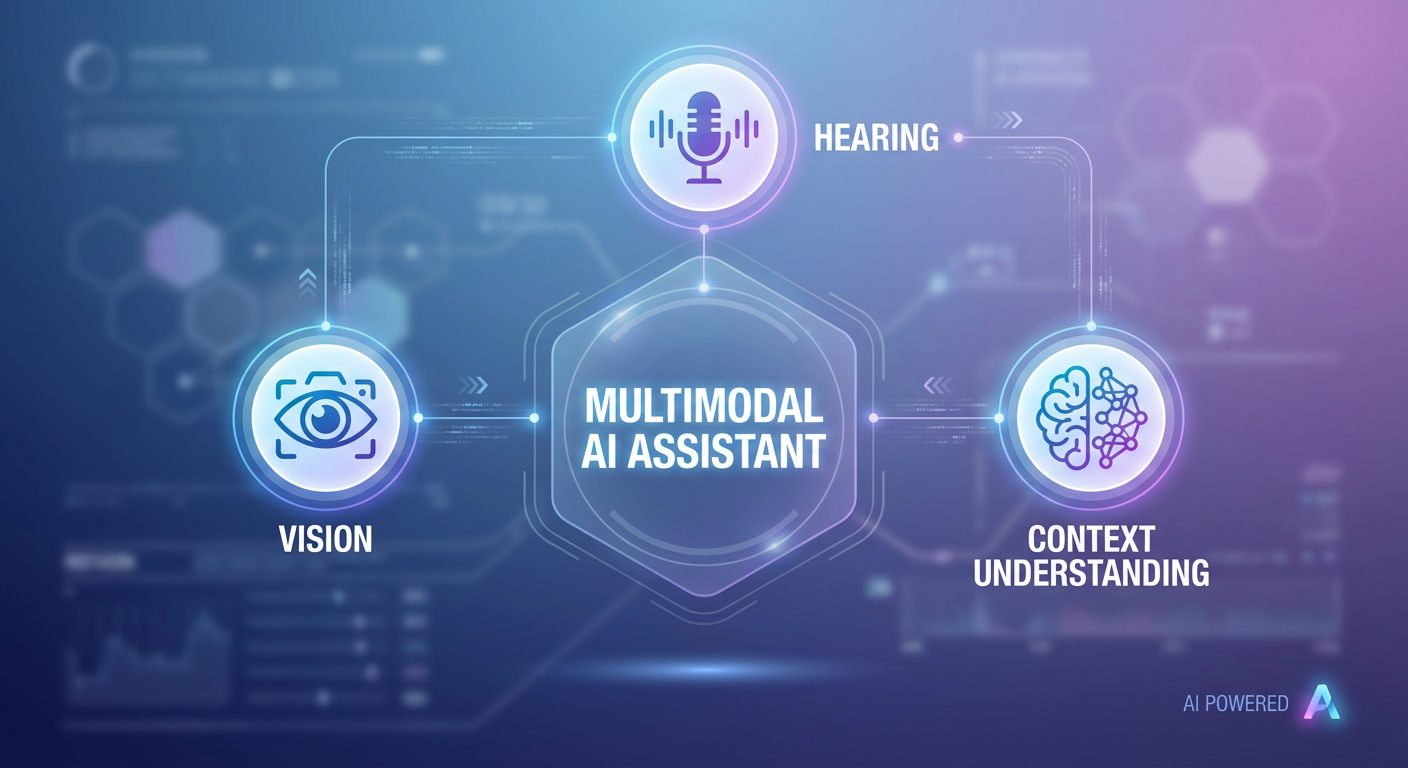
Traditional AI tools could only process one type of input at a time. Text-based chatbots couldn't see images. Image recognition tools couldn't understand spoken words. But multimodal AI assistants have changed everything by combining visual, auditory, and textual understanding into one unified system.
For marketing directors and business owners, this technology represents a fundamental shift in how you can interact with AI. Instead of switching between multiple tools, you now have access to assistants that truly understand complete context. This article explores how multimodal AI works, its practical applications for your business, and how you can leverage this technology to gain a competitive advantage.
What Are Multimodal AI Assistants and Why Should You Care
Multimodal AI assistants are intelligent systems that can process and understand multiple types of input simultaneously—text, images, audio, video, and even data from sensors or documents. Unlike traditional AI that specializes in one modality, these assistants create a comprehensive understanding by combining information from different sources.
Think of it like this: when you meet with a client, you don't just listen to their words. You observe their body language, review the documents they share, and consider the context of previous conversations. Multimodal AI assistants work the same way, processing all available information to provide more accurate and contextually relevant responses.
According to McKinsey's 2024 AI report, businesses using multimodal AI systems have seen a 37% improvement in customer satisfaction scores and a 42% reduction in time spent on routine analysis tasks. These aren't marginal gains—they're transformative improvements that directly impact your bottom line.
For your business, this means you can finally have an AI assistant that understands the complete picture. When a customer sends an email with product photos, your AI doesn't just read the text—it analyzes the images, recalls previous interactions, and provides comprehensive solutions.
How Multimodal AI Actually Works Behind the Scenes
You don't need a computer science degree to leverage multimodal AI, but understanding the basics helps you make smarter implementation decisions. These systems use multiple specialized neural networks that work together like a well-coordinated team.
The vision component uses convolutional neural networks to analyze images and videos, identifying objects, patterns, text within images, and visual context. The audio component employs speech recognition and natural language understanding to process spoken words, tone, and acoustic patterns. The text processing component uses transformer models to comprehend written language, context, and semantic meaning.
What makes these systems truly powerful is the fusion layer—the technology that combines insights from all these components. This layer doesn't just stack information; it creates connections and understands relationships between different types of data.
For example, when analyzing a social media campaign, a multimodal AI assistant can simultaneously evaluate the visual appeal of your graphics, the sentiment in customer comments, and the engagement patterns in your analytics data. It then synthesizes all this information into actionable recommendations.
Gartner predicts that by 2026, over 60% of enterprise AI applications will incorporate multimodal capabilities, compared to just 15% in 2023. This rapid adoption reflects the technology's maturity and proven value.
Practical Applications That Transform Marketing Operations
The real question isn't what multimodal AI assistants can do—it's how you can use them to solve your specific business challenges. Let's explore concrete applications that are already delivering results for companies like yours.
Content Creation and Optimization: Multimodal AI assistants can analyze top-performing content across your industry by examining images, videos, text, and engagement metrics simultaneously. You can upload competitor content, describe your target audience verbally, and share visual brand guidelines—the AI processes everything to generate content recommendations that align perfectly with your brand voice and visual identity.
Customer Service Enhancement: When customers submit support tickets with screenshots, voice messages, or video demonstrations of problems, multimodal AI can immediately understand the complete issue. A retail company reported reducing average resolution time from 48 hours to 6 hours by implementing multimodal support assistants that could instantly analyze product images and customer descriptions together.
Market Research and Competitive Analysis: You can ask your AI assistant to analyze competitor websites, review customer testimonial videos, examine product packaging photos, and synthesize written reviews—all in one request. The assistant provides comprehensive competitive insights that would traditionally require days of manual research.
Ad Campaign Performance Analysis: Upload campaign creatives, share performance data, and describe your campaign goals verbally. The multimodal assistant analyzes visual elements, correlates them with performance metrics, and identifies specific design elements or messaging that drives results.
Real-World Examples From Leading Companies
Seeing how other businesses leverage multimodal AI assistants helps you envision possibilities for your own organization. Here are verified examples from 2024-2025 implementations.
Shopify's Product Catalog Management: Shopify integrated multimodal AI to help merchants optimize product listings. The system analyzes product photos, reads descriptions, and compares them against top-performing listings in similar categories. Merchants using this feature reported a 28% increase in conversion rates within the first quarter.
HubSpot's Content Strategy Assistant: HubSpot's AI analyzes blog post text, featured images, video content, and engagement data simultaneously to recommend content improvements. Marketing teams using this tool reduced content planning time by 45% while improving engagement metrics.
Canva's Design Intelligence: Canva's multimodal AI understands design requests that combine text descriptions, reference images, and brand guidelines. Users can describe what they want verbally, upload inspiration photos, and the AI generates designs that incorporate elements from all inputs.
Salesforce's Einstein GPT: This CRM-integrated multimodal assistant analyzes customer emails, attached documents, meeting recordings, and historical data to provide sales representatives with comprehensive customer insights before every interaction. Sales teams reported 34% higher close rates when using complete context features.
These aren't futuristic concepts—they're operational systems delivering measurable results today. The barrier to entry continues to decrease, making these capabilities accessible to businesses of all sizes.
Benefits That Directly Impact Your Bottom Line
Understanding the business value helps you justify investment and prioritize implementation. Multimodal AI assistants deliver benefits across multiple dimensions of your operations.
Time Savings: Instead of manually switching between tools to analyze different data types, you interact with one assistant that processes everything. Marketing directors report saving 10-15 hours weekly on routine analysis and reporting tasks.
Improved Decision Quality: Decisions based on complete context are inherently better than those based on partial information. When your AI assistant considers visual, textual, and auditory data together, recommendations become more accurate and actionable.
Enhanced Customer Understanding: Customers communicate through multiple channels and formats. An assistant that understands images customers share, voice messages they leave, and text they write provides deeper insights into their needs and preferences.
Competitive Advantage: According to Forrester Research, companies using multimodal AI for market intelligence identify competitive threats 3.5 times faster than those using traditional monitoring tools. Early awareness creates opportunity for proactive response.
Scalability Without Proportional Cost: As your business grows, a multimodal AI assistant handles increased volume without requiring proportional increases in human resources. One assistant can analyze thousands of customer interactions daily, identifying patterns humans might miss.
Consistency Across Channels: The same AI assistant that analyzes your website can evaluate your social media, review email campaigns, and assess video content—ensuring consistent insights and recommendations across all marketing channels.
Potential Challenges and How to Overcome Them
Every technology implementation comes with challenges. Being aware of potential obstacles helps you plan effectively and avoid common pitfalls.
Data Privacy and Security Concerns: Multimodal systems process sensitive information across multiple formats. Ensure your chosen solution offers enterprise-grade encryption, complies with GDPR and other relevant regulations, and provides clear data governance controls. Ask vendors specific questions about where data is stored and how it's protected.
Integration Complexity: Connecting multimodal AI with your existing marketing stack can be challenging. Start with platforms that offer pre-built integrations with popular tools like your CRM, email marketing platform, and analytics systems. Consider working with implementation partners who specialize in your industry.
Learning Curve: Your team needs time to adapt to new workflows. Invest in proper training and start with limited use cases before expanding. Companies that implement gradually report 60% higher adoption rates than those attempting organization-wide rollouts immediately.
Cost Considerations: Advanced multimodal AI can require significant investment. Start with clear ROI metrics and pilot programs that demonstrate value before scaling. Many platforms offer usage-based pricing that allows you to start small and expand as you prove value.
Accuracy and Reliability: While impressive, multimodal AI isn't perfect. Implement verification processes for critical decisions and maintain human oversight, especially in customer-facing applications. Use the AI to augment human decision-making, not replace it entirely.
Choosing the Right Multimodal AI Assistant for Your Business
With numerous options available in 2025, selecting the right solution requires careful evaluation. Consider these essential criteria when evaluating platforms.
Capability Alignment: Different assistants excel at different tasks. Claude and GPT-4V offer strong vision and text capabilities. Google's Gemini excels at processing video content. Microsoft Copilot integrates deeply with Office applications. Match capabilities to your specific use cases.
Integration Ecosystem: Evaluate how well the assistant connects with your existing tools. Native integrations with your CRM, marketing automation platform, and analytics tools reduce implementation complexity significantly.
Scalability and Performance: Consider both current needs and future growth. Can the platform handle your projected volume in 12-24 months? What happens during peak usage periods? Request performance benchmarks from vendors.
Customization Options: The ability to fine-tune the AI with your specific data, brand guidelines, and industry knowledge dramatically improves relevance. Look for platforms that allow custom training without requiring data science expertise.
Support and Documentation: Quality implementation support, comprehensive documentation, and responsive customer service become critical when issues arise. Evaluate vendor support capabilities before committing.
Cost Structure: Understand total cost of ownership including licenses, API calls, storage, and integration expenses. Some platforms charge per user, others per interaction or data volume. Model costs across different usage scenarios.
Getting Started: Your Implementation Roadmap
Successful implementation follows a structured approach. Here's your step-by-step roadmap for introducing multimodal AI assistants into your marketing operations.
Phase 1 - Identify Use Cases (Week 1-2): Gather your team and identify specific pain points where multimodal capabilities would provide immediate value. Prioritize use cases with clear success metrics and minimal dependencies on other systems.
Phase 2 - Platform Evaluation (Week 3-4): Test 2-3 platforms with your actual data and use cases. Most vendors offer trial periods or proof-of-concept programs. Involve end users in evaluation to ensure the solution fits their workflows.
Phase 3 - Pilot Implementation (Month 2-3): Deploy your chosen solution for a limited use case with a small team. This controlled environment allows you to identify integration issues, refine processes, and demonstrate value before broader rollout.
Phase 4 - Measure and Optimize (Month 3-4): Track defined success metrics rigorously. Compare performance against baseline measurements. Gather user feedback and optimize configurations based on real-world usage patterns.
Phase 5 - Scale Strategically (Month 5+): Expand to additional use cases and teams based on proven success. Develop internal expertise and best practices. Consider advanced customization as your team's proficiency increases.
Remember that successful AI implementation is a journey, not a destination. Technology evolves rapidly, and your use cases will expand as you discover new applications.
The Future of Multimodal AI in Marketing
Understanding where technology is heading helps you make future-proof decisions today. Several trends are shaping the next generation of multimodal AI assistants.
Real-Time Processing: Current systems analyze uploaded content, but emerging capabilities enable real-time analysis of live video calls, streaming data, and ongoing customer interactions. Imagine AI assistants that provide suggestions during client presentations based on visual cues and conversation flow.
Emotional Intelligence: Advanced systems are learning to detect emotional context from facial expressions in video, tone in audio, and sentiment in text—simultaneously. This emotional awareness creates opportunities for more empathetic customer interactions.
Predictive Capabilities: By analyzing patterns across visual, textual, and auditory data over time, multimodal AI increasingly predicts customer behavior, market trends, and campaign performance before they happen.
Augmented Reality Integration: As AR becomes mainstream in marketing, multimodal AI that understands 3D environments, spatial relationships, and interactive experiences will become essential for creating immersive brand experiences.
Autonomous Decision-Making: While current systems recommend actions, future iterations will autonomously execute routine decisions based on complete context understanding, with human oversight for exceptions only.
IDC forecasts the multimodal AI market will reach $47 billion by 2027, growing at 38% annually. This investment reflects business confidence in the technology's transformative potential.
Conclusion: Your Next Steps to Leverage Complete Context AI
Multimodal AI assistants represent more than incremental improvement—they're a fundamental shift in how businesses can understand and respond to complex challenges. By processing visual, auditory, and textual information simultaneously, these systems provide the complete context understanding that drives better decisions, faster operations, and superior customer experiences.
You now understand what multimodal AI assistants are, how they work, their practical applications, real-world examples, benefits, challenges, and implementation strategies. The question isn't whether this technology will transform marketing—it already is. The question is whether you'll adopt it proactively or reactively.
Start small but start now. Identify one use case where complete context understanding would provide immediate value. Test a platform during a free trial. Measure results rigorously. Then scale based on proven success.
The businesses that thrive in 2025 and beyond will be those that leverage AI systems capable of seeing, hearing, and understanding complete context—just like humans do, but at unprecedented scale and speed.
Ready to explore multimodal AI for your business? Download our free implementation checklist that walks you through platform evaluation, use case identification, and ROI measurement. Subscribe to our newsletter for weekly insights on AI in marketing, or schedule a consultation with our team to discuss your specific needs and opportunities.