Introduction
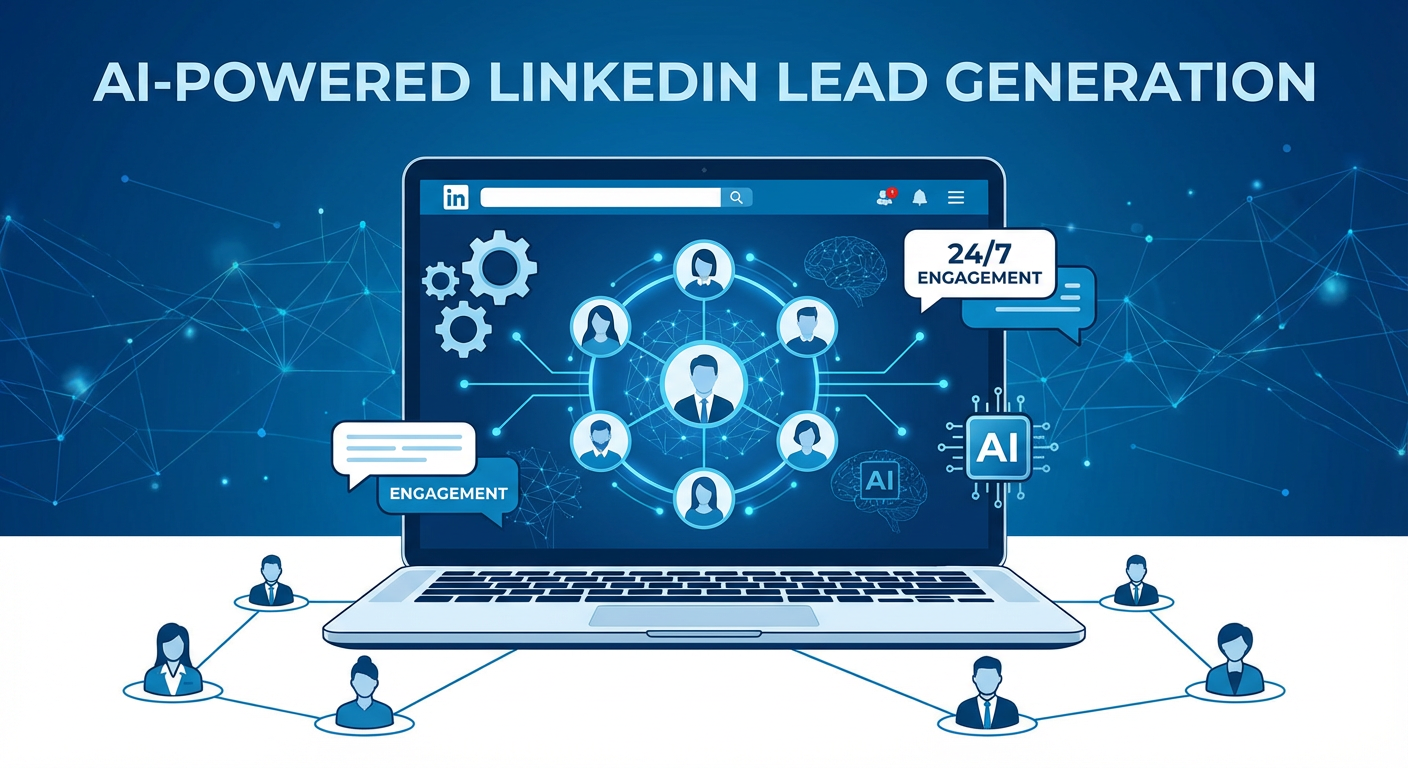
Imagine waking up to qualified leads who've already been nurtured, engaged, and moved through your sales pipeline—all while you slept. That's not a fantasy anymore. In 2025, artificial intelligence has revolutionized LinkedIn lead generation, enabling businesses to connect with prospects, personalize outreach, and close deals 24/7 without triggering LinkedIn's strict anti-spam algorithms.
But here's the catch: one wrong move and your account could be restricted or banned. LinkedIn has become increasingly sophisticated at detecting automated behavior, making it crucial to use AI strategically and compliantly. This article shows you exactly how to leverage AI for LinkedIn lead generation in 2025 while staying firmly within platform guidelines. You'll discover the latest AI tools, proven strategies, and safety protocols that marketing directors and business owners are using to generate consistent results without risking their accounts.
Why LinkedIn Lead Gen Matters More Than Ever in 2025
LinkedIn has evolved from a simple networking platform into the world's most powerful B2B sales engine. With over 930 million users globally and 67 million companies represented, it's where decision-makers spend their time researching solutions and building professional relationships.
According to LinkedIn's 2025 State of Sales report, 78% of B2B buyers prefer engaging with sales professionals who provide personalized, relevant content—not generic pitches. Meanwhile, HubSpot research shows that LinkedIn generates 277% more leads than Facebook and Twitter combined for B2B companies.
The problem? Manual prospecting is time-intensive and doesn't scale. Sales teams spend an average of 21% of their day writing emails and another 17% prospecting and researching leads, according to Salesforce data. That's where AI enters the picture, automating repetitive tasks while maintaining the personalization that converts cold prospects into warm opportunities.
Understanding LinkedIn's Anti-Spam Measures in 2025
Before diving into AI strategies, you need to understand what gets accounts flagged. LinkedIn's algorithms have become incredibly sophisticated, using machine learning to detect patterns associated with automation and spam.
LinkedIn monitors several key behaviors: connection request velocity (how many invites you send per day), message frequency, profile viewing patterns, and engagement authenticity. Send too many connection requests too quickly, use repetitive messaging, or exhibit robotic behavior patterns, and you'll trigger red flags.
In 2024-2025, LinkedIn introduced advanced behavioral analysis that examines not just what you do, but how you do it. The platform now analyzes typing patterns, mouse movements, session durations, and even time gaps between actions. Simple bots that worked in previous years are now easily detected and swiftly penalized.
The consequences are serious. LinkedIn implements progressive penalties: temporary restrictions on connection requests, message sending limits, weekly limits that don't reset, and ultimately permanent account suspension. For business accounts with established networks and reputation, these penalties can be devastating.
How AI Bypasses Restrictions While Staying Compliant
The key to successful AI-powered LinkedIn lead generation in 2025 isn't avoiding automation—it's implementing smart automation that mimics natural human behavior.
Modern AI tools use sophisticated algorithms that randomize timing, vary message templates, and introduce human-like delays between actions. Instead of sending 100 connection requests at precisely 9:00 AM every morning, AI systems distribute activities throughout the day with variable intervals that mirror how real users engage.
Advanced AI platforms now incorporate behavioral fingerprinting that replicates authentic user patterns. These systems analyze your historical LinkedIn usage and create automation sequences that match your natural activity rhythms. If you typically log in between 8-10 AM and 2-4 PM, the AI respects those patterns.
Machine learning models continuously adapt based on LinkedIn's algorithm changes. When the platform updates its detection mechanisms, leading AI tools automatically adjust their behavior patterns to maintain compliance. This dynamic adaptation is what separates 2025's AI solutions from earlier generation automation tools.
Top AI Tools Transforming LinkedIn Lead Generation
Several AI-powered platforms have emerged as leaders in compliant LinkedIn automation for 2025.
Expandi has established itself as one of the safest options, using cloud-based automation that doesn't require browser extensions. It operates from dedicated IP addresses and implements smart limits that automatically adjust based on your account age and activity history. Expandi's AI personalizes messages using profile data like recent posts, shared connections, and company information.
lemlist now offers LinkedIn integration with AI-powered email sequences, creating multi-channel campaigns that engage prospects on LinkedIn and through email simultaneously. Their AI analyzes prospect behavior across channels to determine optimal next steps automatically.
Dux-Soup has evolved significantly, incorporating AI that scores leads based on engagement likelihood before initiating contact. This pre-qualification reduces wasted outreach and improves response rates while keeping daily volumes within safe limits.
Sales Navigator with native AI features represents LinkedIn's own foray into intelligent automation. While more limited than third-party tools, it offers completely compliant lead recommendations, AI-generated message suggestions, and automated alerts for prospect activity.
Instantly.ai combines LinkedIn outreach with sophisticated AI email sequences, using natural language processing to craft personalized messages that reference specific details from prospects' profiles and recent activity.
Each platform employs different safety mechanisms, but the best ones share common features: human-behavior simulation, intelligent daily limits, IP rotation, session randomization, and continuous algorithm monitoring.
Building an AI-Powered Lead Generation Workflow
Successful LinkedIn lead generation in 2025 requires a strategic workflow that combines AI automation with human oversight.
Start with precise targeting. Use LinkedIn's advanced search filters or Sales Navigator to identify your ideal customer profile based on job title, industry, company size, geography, and recent activity. The more specific your criteria, the more effectively AI can personalize outreach.
Next, implement AI-powered lead scoring. Modern tools analyze dozens of signals—profile completeness, recent post engagement, shared connections, company growth indicators, job change timing—to predict which prospects are most likely to respond positively. This ensures you're spending automation bandwidth on high-value targets.
Create message templates with AI personalization variables. Instead of generic "I saw your profile" messages, use AI that incorporates specific details: recent posts they've shared, common connections, relevant company news, or industry trends. For example: "Noticed your recent post about {{recentposttopic}}—we've helped similar {{jobtitle}} professionals solve {{painpoint}} at companies like {{similar_company}}."
Set up multi-touch sequences that span weeks, not days. A typical AI-powered sequence might include: initial connection request with personalized note, follow-up message 3-4 days post-connection, value-add content share 5-7 days later, soft CTA message after 10-14 days, and final check-in after 3 weeks. AI manages timing and tracks engagement automatically.
Integrate LinkedIn outreach with email sequences. When prospects don't respond on LinkedIn, AI tools can automatically trigger email follow-ups using contact information from enrichment databases. This multi-channel approach increases response rates by 40-60% according to Outreach.io's 2025 benchmarks.
AI-Powered Personalization at Scale
The paradox of automation is that success requires personalization. Generic messages get ignored; personalized outreach converts. AI has finally solved this paradox in 2025.
Natural language processing models like GPT-4 and Claude can now analyze prospect profiles and generate genuinely personalized messages that reference specific details without sounding robotic. These systems identify talking points from recent posts, shared background elements, mutual connections, and company initiatives.
Sentiment analysis helps AI understand the tone and content preferences of different prospect segments. For C-level executives, messages become more concise and value-focused. For mid-level managers, AI incorporates more tactical details and implementation specifics.
Dynamic content insertion goes beyond simple name variables. Modern AI pulls recent company funding announcements, new product launches, hiring trends, and industry news to create contextually relevant opening lines. When a prospect's company just raised Series B funding, AI mentions growth challenges relevant to that stage.
Conversational AI now handles initial message exchanges, answering common questions and qualifying prospects before human takeover. These systems recognize buying signals—questions about pricing, implementation timelines, case studies—and automatically alert sales reps to jump in personally.
Monitoring Performance and Staying Under the Radar
Even with compliant AI tools, you need to actively monitor your LinkedIn activity to ensure ongoing safety.
Track your key metrics weekly: connection request acceptance rate (aim for 30%+ to signal relevance), message response rate (15-25% is healthy for cold outreach), profile view-to-connection ratio, and weekly activity volumes. Sudden drops in acceptance or response rates may indicate LinkedIn is limiting your visibility.
Maintain conservative daily limits. Even though AI tools can theoretically send 100+ connection requests daily, best practice in 2025 is 20-40 for established accounts and 10-20 for newer profiles. Messages should stay under 50-75 per day across all sequences.
Regularly audit your AI-generated messages. Review what your automation is actually sending to ensure quality remains high and personalization variables are populating correctly. Nothing triggers spam reports faster than "Hi {{first_name}}" messages with broken variables.
Mix automated activities with genuine engagement. Spend 15-30 minutes daily manually commenting on prospects' posts, sharing relevant content, and engaging authentically. This human activity creates a natural usage pattern that shields automated actions.
Monitor LinkedIn's native analytics to track Social Selling Index (SSI), profile views, and search appearances. Declining SSI often precedes account restrictions, serving as an early warning signal.
Combining AI with Human Touch for Maximum Results
The most successful LinkedIn lead generation strategies in 2025 aren't fully automated—they're AI-assisted with strategic human intervention.
Use AI to handle prospecting, initial outreach, and qualification, but have sales reps personally take over once prospects show genuine interest. The handoff point typically occurs when prospects ask specific questions, request demos, or mention timelines.
Create AI-triggered alerts for high-value opportunities. When a target account executive views your profile multiple times, engages with your content, or visits your website, AI should notify your team immediately for personal follow-up while the prospect is warm.
Leverage AI for research and briefing documents. Before important calls or meetings, AI tools can compile comprehensive prospect profiles including recent activity, pain points mentioned in posts, company initiatives, and competitive context. This preparation makes human interactions far more valuable.
Implement feedback loops where sales reps rate AI-generated messages and suggest improvements. Machine learning models use this feedback to continuously refine messaging, improving relevance and response rates over time.
Real-World Success Stories and Case Studies
A SaaS company specializing in HR technology implemented Expandi with customized AI sequences in early 2025. They targeted HR directors at mid-market companies, using AI to reference specific hiring challenges mentioned in prospects' recent posts. Within 90 days, they generated 340 qualified leads with a 23% connection acceptance rate and 18% message response rate—all while keeping daily volumes under 30 connections.
A B2B consulting firm combined lemlist's LinkedIn integration with email sequences, using AI to determine which channel prospects preferred based on engagement patterns. Their multi-channel approach increased booked consultations by 156% compared to LinkedIn-only outreach, while maintaining complete compliance with both LinkedIn and email regulations.
A marketing agency serving e-commerce brands used AI lead scoring to identify prospects at companies experiencing rapid growth (tracked through hiring velocity and funding announcements). By targeting these high-intent prospects with timely, relevant outreach, they achieved a 31% response rate—nearly double the industry average of 16-18% for cold LinkedIn outreach.
Common Mistakes That Get Accounts Banned
Even with AI tools, certain practices will trigger LinkedIn's enforcement mechanisms.
Avoid using multiple automation tools simultaneously. Running Expandi and Dux-Soup at the same time creates conflicting action patterns that LinkedIn's algorithms easily detect as artificial.
Never use free VPNs or frequently changing IP addresses with automation tools. Consistent IP addresses signal legitimate usage; rapid IP changes look like bot behavior designed to avoid detection.
Don't ignore connection request withdrawal. If you've sent connection requests that remain pending for 2-3 weeks, withdraw them before sending new requests. Accumulating hundreds of pending invites signals spam behavior.
Avoid identical message templates across campaigns. Sending the exact same message to 500 prospects creates a clear spam signature. Use AI to create 10-15 template variations with different structures and phrasings.
Never purchase connection lists or use scraped contact data. LinkedIn can detect when you're targeting users through data obtained outside the platform, and this violation typically results in immediate suspension.
The Future of AI in LinkedIn Lead Generation
Looking ahead through 2025 and beyond, several trends are shaping the evolution of AI-powered LinkedIn outreach.
Predictive timing algorithms will become more sophisticated, analyzing prospect behavior patterns to determine optimal contact moments. Instead of generic "Tuesday at 10 AM" approaches, AI will identify when specific individuals are most receptive based on their historical engagement patterns.
Voice and video personalization will emerge as differentiators. AI tools are beginning to generate personalized video messages and voice notes at scale, using synthetic media that sounds natural while remaining ethical and transparent.
Intent data integration will allow AI systems to detect buying signals across the entire web—not just LinkedIn. When a prospect researches your solution category, visits competitor websites, or engages with relevant content elsewhere, AI will trigger timely LinkedIn outreach.
Conversational AI will handle increasingly complex exchanges before human handoff. These systems will answer technical questions, share case studies, and even negotiate meeting times through natural dialogue that prospects can't distinguish from human communication.
LinkedIn itself will likely introduce more native AI features, potentially reducing the need for third-party tools while setting new compliance standards that external platforms must match.
Recommended Resources for Further Learning
To deepen your understanding of AI-powered LinkedIn lead generation, explore these valuable resources.
LinkedIn's Official Sales Solutions Blog provides regular updates on platform policies, new features, and best practices directly from the source. Understanding LinkedIn's perspective helps you stay compliant while maximizing results.
The AI Sales Automation Podcast features interviews with practitioners implementing AI across various sales channels, including extensive LinkedIn discussion and case studies.
Books like "Fanatical Prospecting" by Jeb Blount and "The Sales Development Playbook" by Trish Bertuzzi provide foundational sales principles that remain relevant even as AI handles execution.
Online communities such as the Modern Sales Professionals group on LinkedIn and various subreddits like r/sales and r/B2BSales offer peer insights, tool recommendations, and troubleshooting advice from practitioners navigating the same challenges.
Vendor-specific training programs from platforms like Expandi Academy, lemlist University, and Sales Navigator Learning Path provide tactical implementation guidance for specific tools.
Conclusion
LinkedIn lead generation in 2025 has reached an inflection point where AI automation is no longer optional—it's essential for competitive advantage. But success requires a strategic approach that balances automation efficiency with compliance safety and human authenticity.
By implementing the AI-powered tools and workflows outlined in this article, you can generate qualified leads around the clock without risking account penalties. Focus on smart targeting, genuine personalization, conservative daily limits, and strategic human intervention at critical moments.
The businesses winning on LinkedIn aren't using the most aggressive automation—they're using the smartest automation combined with authentic relationship building. AI handles the repetitive prospecting and initial outreach that would otherwise consume your team's time, freeing them to focus on high-value conversations with qualified prospects.
Remember: LinkedIn lead generation with AI is about working smarter, not harder. It's about reaching the right people with relevant messages at optimal times, then building genuine relationships that convert into long-term business partnerships.
Ready to transform your LinkedIn lead generation strategy? Start by selecting one AI tool that matches your use case, implementing conservative automation limits, and monitoring performance closely. As you gain confidence and results, gradually expand your AI-powered workflows while maintaining strict compliance protocols.
Want personalized guidance on implementing AI for your specific LinkedIn lead generation needs? Download our free LinkedIn AI Automation Checklist or schedule a consultation with our team to discuss a customized strategy for your business.