Introduction
Have you ever wished your automated customer service could understand not just what your customers are saying, but how they're feeling? In 2025, that's no longer wishful thinking. Emotional Intelligence in AI Voice Assistants: How Sentiment Analysis is Revolutionizing Customer Experience in 2025 is transforming how businesses interact with customers at every touchpoint.
As a marketing director or business owner, you're facing increasing pressure to deliver exceptional customer experiences while managing costs. Traditional voice assistants handle basic queries, but they've always lacked something fundamentally human—the ability to recognize and respond to emotions. This article will show you exactly how sentiment analysis is changing that dynamic, which tools are leading the market, and how you can implement this technology to gain a competitive edge.
Understanding Emotional Intelligence in AI Voice Assistants
Emotional intelligence in AI refers to a system's ability to detect, interpret, and appropriately respond to human emotions during interactions. Unlike conventional voice assistants that simply parse words and execute commands, emotionally intelligent systems analyze vocal tone, speech patterns, word choice, and contextual cues to gauge a customer's emotional state.
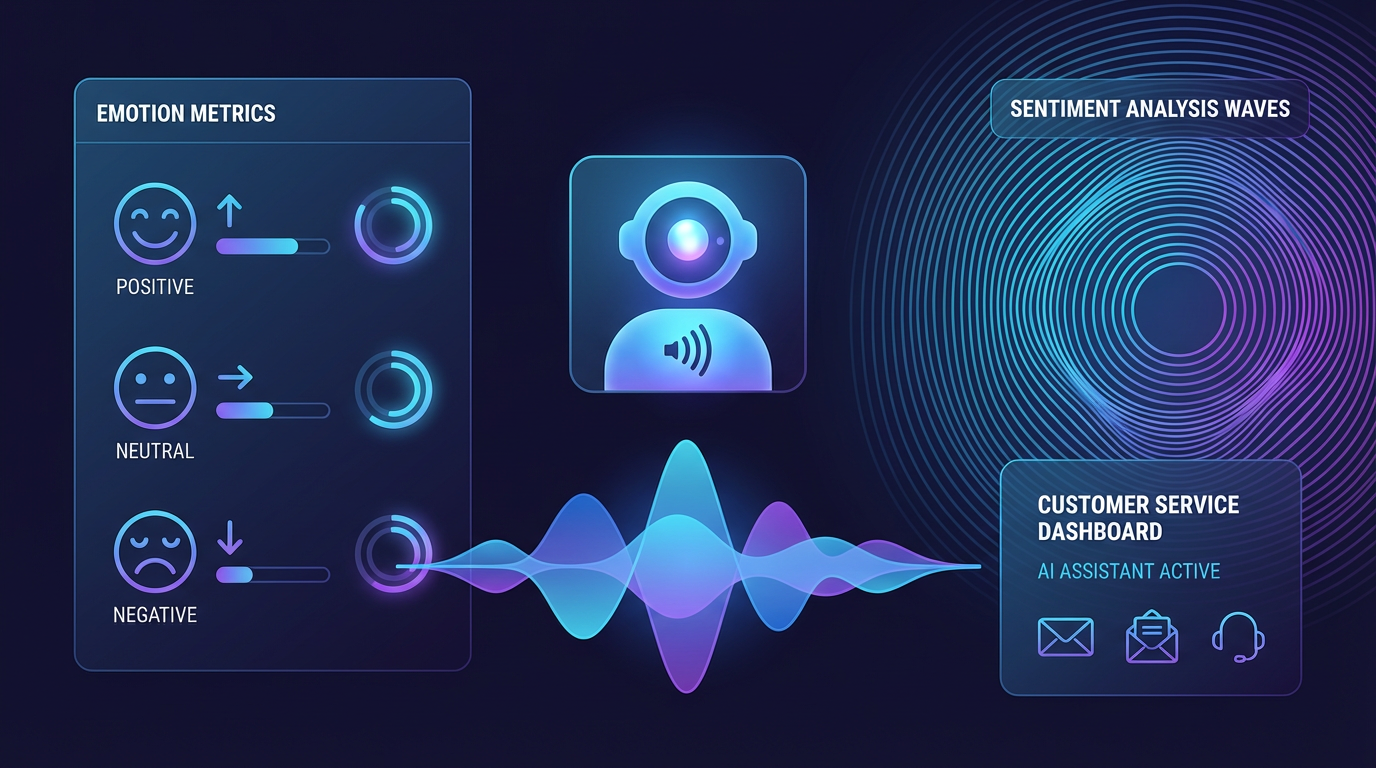
Sentiment analysis serves as the technological backbone of this capability. It employs natural language processing (NLP), machine learning algorithms, and acoustic analysis to decode emotional signals in real-time conversations. When a customer speaks, the AI simultaneously processes the content (what they're saying) and the emotion (how they're saying it).
According to a 2025 report by McKinsey & Company, businesses implementing emotionally intelligent AI voice assistants have seen customer satisfaction scores increase by an average of 32% and customer retention improve by 24%. These aren't marginal gains—they represent fundamental improvements in how customers experience your brand.
The technology works through multiple layers. First, voice pattern recognition analyzes pitch variations, speaking speed, volume changes, and pauses. A customer speaking rapidly with a raised voice signals frustration, while hesitant speech with frequent pauses might indicate confusion. Second, natural language processing examines word choices, sentence structure, and linguistic markers that reveal emotional states. Finally, contextual understanding considers the customer's history, current situation, and conversation flow to provide comprehensive emotional context.
How Sentiment Analysis Powers Real-Time Emotional Recognition
Sentiment analysis in voice assistants operates through sophisticated multi-layered processing that happens in milliseconds. Understanding this process helps you appreciate the technology's capabilities and limitations.
Acoustic Feature Extraction: The system analyzes raw audio to identify emotional markers. Research from MIT's Media Lab shows that acoustic features alone can predict emotional states with approximately 72% accuracy. These features include pitch range, speech rate, energy levels, and voice quality characteristics.
Natural Language Understanding: The AI processes the transcript to identify sentiment-bearing words and phrases. Terms like "frustrated," "disappointed," or "excellent" carry obvious emotional weight, but the system also recognizes subtle indicators like "I guess" (uncertainty) or "whatever" (disengagement).
Contextual Analysis: The most advanced systems, like those developed by Google's Contact Center AI and Amazon Connect, incorporate conversation history and customer data. If a customer is calling for the third time about the same issue, the context amplifies any detected frustration signals.
Emotional Scoring: The AI assigns real-time emotion scores across multiple dimensions—joy, anger, sadness, surprise, fear, and neutral states. These scores update continuously as the conversation progresses, allowing the system to detect emotional shifts.
A practical example: When Vodafone UK implemented sentiment-aware voice assistants in late 2024, their system detected that 23% of customers calling about billing issues exhibited stress indicators even before explaining their problem. The AI automatically adjusted its approach, using more reassuring language and offering immediate escalation paths, resulting in a 41% reduction in billing-related complaints.
Real-World Applications Transforming Customer Experience
Let's examine specific examples of how businesses are leveraging emotional intelligence in AI voice assistants to create measurable impact.
Financial Services - Capital One: Capital One's Eno assistant now incorporates emotional intelligence to detect financial stress or anxiety in customers' voices. When the system identifies these signals during conversations about credit limits or payment issues, it automatically offers relevant financial wellness resources and connects customers with specialized support teams. Since implementation in early 2025, Capital One reported a 28% decrease in customer churn among users who interacted with the emotionally aware system.
Healthcare - Cleveland Clinic: The Cleveland Clinic deployed sentiment-aware voice assistants for appointment scheduling and patient support. The system recognizes when patients express pain, urgency, or medical anxiety through vocal cues and automatically prioritizes their needs. Urgent cases get routed to triage nurses within 90 seconds. This emotionally intelligent routing reduced emergency room visits by 17% by catching urgent cases through phone interactions.
E-commerce - Shopify Merchants: Shopify integrated emotional AI into their merchant support system. When small business owners call with technical issues, the system detects stress levels and adjusts response strategies. High-stress calls receive immediate human escalation, while moderate concerns get detailed step-by-step guidance from the AI. Merchant satisfaction scores improved by 36% in the first quarter of 2025.
Travel Industry - Lufthansa: Lufthansa's customer service voice system analyzes emotional states during flight disruption calls. When passengers exhibit high stress about missed connections or cancelled flights, the AI proactively offers compensation, hotel arrangements, or rebooking options without requiring customers to ask. This approach reduced complaint escalations by 52% and improved Net Promoter Scores by 19 points.
These examples demonstrate that emotional intelligence in AI voice assistants isn't a futuristic concept—it's delivering tangible results today across diverse industries.
Key Benefits for Your Business
Implementing emotionally intelligent voice assistants delivers strategic advantages that directly impact your bottom line and competitive positioning.
Enhanced Customer Satisfaction: Customers feel heard and understood when AI responds appropriately to their emotional state. Research from Forrester indicates that 89% of customers who experienced emotionally aware AI interactions rated them as "good" or "excellent," compared to just 54% for traditional automated systems.
Improved First-Contact Resolution: Sentiment analysis helps route customers more effectively. Emotionally complex situations escalate to experienced human agents, while straightforward queries stay with AI. This intelligent routing increased first-contact resolution rates by 38% for companies in Gartner's 2025 Customer Experience benchmark study.
Reduced Customer Churn: Detecting and addressing emotional distress early prevents customer attrition. When your voice assistant recognizes frustration and takes corrective action—offering discounts, expediting resolutions, or providing empathetic responses—customers are 3.2 times more likely to remain loyal, according to Salesforce's State of the Connected Customer 2025 report.
Cost Optimization: While emotionally intelligent systems handle more complex interactions than basic AI, they still cost significantly less than human agents. The average cost per interaction drops from $8-12 for human agents to $2-4 for advanced AI, according to ContactBabel's 2025 industry analysis.
Actionable Customer Insights: Aggregated sentiment data reveals patterns about which products, services, or processes generate positive or negative emotional responses. You'll discover friction points in your customer journey that weren't visible through traditional analytics.
24/7 Emotional Availability: Unlike human teams requiring breaks and shift coverage, emotionally intelligent AI provides consistent, empathetic responses around the clock. This constant availability particularly benefits global businesses serving multiple time zones.
Leading Platforms and Technologies in 2025
Choosing the right emotional AI platform requires understanding the current market landscape and each solution's strengths.
Google Contact Center AI (CCAI): Google's platform leads in multilingual sentiment analysis, supporting accurate emotion detection across 50+ languages. Its integration with Google Cloud's analytics tools provides comprehensive emotional journey mapping. Pricing starts at $0.06 per conversation, making it accessible for mid-sized businesses. Best for: Companies with international customer bases requiring multilingual emotional intelligence.
Amazon Connect with Contact Lens: Amazon's solution excels in real-time sentiment tracking and supervisor alerting. When conversations turn negative, supervisors receive instant notifications enabling proactive intervention. The platform's pay-as-you-go model (approximately $0.015 per minute) suits businesses with variable call volumes. Best for: Organizations prioritizing real-time monitoring and intervention capabilities.
Microsoft Azure Cognitive Services for Language: Microsoft's offering provides deep integration with Microsoft 365 and Dynamics 365 CRM systems. Its sentiment analysis achieves 87% accuracy across voice and text channels, according to independent testing by Opus Research. Best for: Enterprises already invested in Microsoft's ecosystem.
IBM Watson Assistant: Watson emphasizes industry-specific emotional models trained on healthcare, financial services, and retail datasets. This specialization delivers higher accuracy for sector-specific emotional nuances. Implementation costs typically range from $50,000-$200,000 depending on scale. Best for: Regulated industries requiring specialized emotional understanding.
Genesys Cloud CX: Genesys offers robust omnichannel emotional consistency, ensuring sentiment analysis works uniformly across voice, chat, email, and social media. This consistency creates seamless emotional experiences regardless of communication channel. Best for: Businesses providing support across multiple channels.
When evaluating platforms, request proof-of-concept demonstrations using your actual customer data and scenarios. Most providers offer 30-60 day pilot programs allowing you to test effectiveness before full commitment.
Implementation Best Practices and Strategies
Successful deployment of emotionally intelligent voice assistants requires strategic planning and thoughtful execution.
Start with High-Impact Use Cases: Don't attempt to implement everywhere simultaneously. Identify your highest-pain customer interactions—typically complaint handling, technical support escalations, or appointment scheduling. Focus initial deployment here to demonstrate clear ROI.
Define Clear Emotional Triggers and Responses: Work with your customer service team to map emotional states to appropriate responses. For example, detected anger might trigger immediate apology language and human escalation offers, while confusion prompts slower, more detailed explanations.
Set Appropriate Escalation Thresholds: Determine when emotionally charged situations should transfer to human agents. Most successful implementations escalate when anger scores exceed 70/100, when customers explicitly request humans, or when the AI's confidence in handling the emotional complexity falls below 60%.
Train Your Human Team: Your customer service representatives need training on how emotional AI works and how to leverage the insights it provides. When escalated calls arrive, agents should see the customer's emotional journey and previous interaction attempts.
Monitor and Refine Continuously: Emotional AI improves through ongoing training. Review recordings of mishandled interactions weekly during the first three months. Update emotional triggers, refine response scripts, and retrain models based on real-world performance.
Communicate Transparently with Customers: Be upfront about using AI that analyzes emotional cues. A simple disclosure like "This call uses AI to better understand and serve you" builds trust. Research from the Pew Research Center shows 71% of consumers accept emotional AI when informed about it and its benefits.
Balance Efficiency with Empathy: Don't optimize purely for speed. Sometimes emotionally distressed customers need the AI to pause, acknowledge their feelings, and provide reassurance before problem-solving. Build these empathetic pauses into conversation design.
Challenges and Ethical Considerations
While emotional intelligence in AI voice assistants offers substantial benefits, you must navigate important challenges and ethical considerations.
Privacy Concerns: Analyzing emotional data raises legitimate privacy questions. You're collecting sensitive information about customers' psychological states. Implement clear consent mechanisms, transparent data usage policies, and comply with GDPR, CCPA, and other privacy regulations. Store emotional data separately from personally identifiable information when possible.
Accuracy Limitations: Current sentiment analysis achieves 85-90% accuracy under optimal conditions, according to Stanford's 2025 AI Accuracy Benchmark. The remaining 10-15% error rate means some emotions will be misread. Misinterpreting frustration as anger or sadness as calmness can worsen situations. Always provide easy mechanisms for customers to correct the AI's emotional assessment.
Cultural and Linguistic Variations: Emotional expression varies significantly across cultures. Directness considered normal in some cultures might register as anger in systems trained predominantly on other cultural norms. Ensure your chosen platform has been trained on diverse, multicultural datasets representing your customer demographics.
The Authenticity Question: Some customers find AI-simulated empathy uncomfortable or manipulative. A 2025 study published in the Journal of Consumer Research found that 31% of participants preferred clearly robotic assistants over those attempting emotional responses. Consider offering customers choice in how your AI presents itself.
Algorithmic Bias: Sentiment analysis systems can inherit biases from training data. Historical research shows some systems performed less accurately for women, non-native speakers, and certain ethnic groups. Regularly audit your system's performance across demographic segments and demand bias testing reports from vendors.
Employee Impact: Implementing emotional AI affects your human customer service team. Some employees fear job displacement, while others worry about AI monitoring. Address these concerns through transparent communication about how the technology augments rather than replaces human roles.
Measuring Success: Essential Metrics
To evaluate your emotional AI implementation effectiveness, track these critical performance indicators.
Emotional Accuracy Rate: Compare AI emotional assessments against customer feedback, survey responses, and outcome data. Calculate the percentage of interactions where the AI correctly identified the customer's emotional state. Aim for 85% or higher accuracy, improving through continuous model training.
Customer Satisfaction by Emotional Journey: Segment CSAT scores by customers' emotional trajectories. Compare satisfaction for customers who started frustrated versus those who began neutral. Effective emotional AI should minimize CSAT differences regardless of starting emotional state—meaning the system successfully de-escalates negative emotions.
Emotional Resolution Rate: Calculate what percentage of emotionally negative interactions (frustration, anger, disappointment) end with positive or neutral emotional states. Top-performing systems achieve emotional resolution in 70-75% of initially negative interactions.
Net Promoter Score Impact: Track NPS changes before and after emotional AI implementation. Industry benchmarks suggest 12-18 point NPS increases within six months for successful deployments.
First-Contact Resolution by Sentiment: Analyze whether emotionally aware routing improves FCR. You should see higher resolution rates because customers reach the right resource (AI or human) based on emotional complexity.
Average Handling Time by Emotional State: Monitor whether the AI appropriately adjusts conversation length based on emotional needs. Distressed customers might need longer interactions, while satisfied customers prefer efficiency.
Escalation Rate and Appropriateness: Track what percentage of interactions escalate to humans and whether those escalations were appropriate based on emotional complexity. Ideal escalation rates typically range from 8-15% depending on industry and use case.
Dashboard these metrics in real-time using tools like Tableau, Power BI, or your platform's native analytics. Weekly reviews during initial implementation phases help identify issues quickly.
The Future of Emotional AI in Customer Experience
Looking ahead, several emerging trends will further transform how emotional intelligence shapes customer interactions.
Multimodal Emotion Recognition: Future systems will combine voice analysis with video facial recognition and text sentiment from chat, creating comprehensive emotional profiles. Early implementations in video-enabled customer service show 18% accuracy improvements over voice-only analysis.
Predictive Emotional Modeling: AI will soon predict emotional responses before customers even contact you. If a customer's flight is delayed and they're booked on a tight connection, the system will anticipate frustration and proactively reach out with solutions before they call.
Hyper-Personalized Emotional Responses: Advanced systems will learn individual emotional preferences over time. Some customers appreciate explicit acknowledgment of their frustration, while others prefer solutions-focused responses without emotional discussion. The AI will adapt its approach based on each customer's demonstrated preferences.
Industry-Specific Emotional Intelligence: Vertical-specific models will emerge with specialized training for healthcare empathy, financial services anxiety management, or retail purchase excitement. This specialization will dramatically improve relevance and effectiveness.
Emotional Consistency Across Channels: Future platforms will maintain emotional context as customers switch from voice to chat to email, ensuring seamless emotional experiences regardless of channel transitions.
According to IDC's Future of Customer Experience 2025-2030 forecast, by 2027, 92% of customer service interactions will involve some form of emotional AI, and customers will increasingly prefer emotionally intelligent AI over basic automation for all but the most complex issues.
Getting Started: Your Action Plan
Ready to implement emotional intelligence in your customer experience strategy? Follow this practical roadmap.
Step 1 - Assess Current Pain Points (Week 1-2): Analyze customer service data to identify where emotional issues cause the most problems. Review complaint patterns, low CSAT scores, and high escalation rates. These pain points become your implementation priorities.
Step 2 - Define Success Metrics (Week 2-3): Establish baseline measurements for CSAT, NPS, first-contact resolution, and average handling time. Set specific improvement targets—for example, "Increase CSAT by 20% for billing inquiries within 6 months."
Step 3 - Evaluate Platform Options (Week 3-5): Request demonstrations from Google CCAI, Amazon Connect, Microsoft Azure, and other platforms. Provide vendors with actual customer scenarios and evaluate how effectively each platform handles your specific emotional challenges.
Step 4 - Run a Pilot Program (Month 2-4): Start with a limited implementation—perhaps 10-20% of calls in one department. This controlled pilot lets you refine approaches, identify issues, and demonstrate ROI before full deployment.
Step 5 - Train Your Team (Month 3-4): Educate customer service representatives, supervisors, and quality assurance teams on how the emotional AI works, how to interpret emotional insights, and how to handle escalated emotionally complex situations.
Step 6 - Scale Gradually (Month 5-8): Expand implementation based on pilot learnings. Roll out to additional departments, use cases, or customer segments in phases, maintaining close monitoring and continuous optimization.
Step 7 - Optimize Continuously (Ongoing): Emotional AI improves through constant refinement. Schedule monthly reviews of emotional accuracy, customer feedback, and business outcomes. Update models, adjust thresholds, and enhance responses based on real-world performance.
Conclusion: Embrace the Emotional Advantage
Emotional Intelligence in AI Voice Assistants: How Sentiment Analysis is Revolutionizing Customer Experience in 2025 represents more than a technological advancement—it's a fundamental shift in how businesses connect with customers on a human level. The companies thriving in today's competitive landscape recognize that exceptional customer experience requires understanding not just what customers need, but how they feel.
You now have a comprehensive understanding of how sentiment analysis works, which platforms lead the market, how successful businesses are implementing this technology, and what challenges to anticipate. The evidence is clear: emotionally intelligent voice assistants deliver measurable improvements in customer satisfaction, retention, and operational efficiency.
The question isn't whether to adopt emotional AI, but how quickly you can implement it to gain competitive advantage. Your competitors are already exploring or deploying these capabilities. Every day you wait, you're potentially losing customers to businesses that understand and respond to emotions more effectively.
Take the next step today: Start by assessing your current customer service pain points and identifying one high-impact use case for emotional AI. Request demonstrations from the platforms mentioned in this article. Most importantly, begin conversations with your team about how emotional intelligence can transform your customer experience.
Want personalized guidance on implementing emotional AI for your specific business? Download our free "Emotional AI Readiness Assessment" checklist or schedule a consultation with our customer experience specialists. The future of customer service is emotionally intelligent—and it's available right now.