Introduction
Every marketing director knows the pain: developing a full-scale campaign traditionally takes weeks of brainstorming, copywriting, design work, and meticulous planning. You're juggling multiple tools, coordinating teams, and constantly racing against deadlines. What if you could compress this entire process into mere minutes? Welcome to the era where you can create full marketing campaigns in minutes: the all-in-one AI content revolution is transforming how businesses approach marketing. This comprehensive guide reveals exactly how AI-powered platforms are enabling marketing teams to generate complete, multi-channel campaigns—from strategy to execution—at unprecedented speed. You'll discover the tools, techniques, and best practices that are reshaping the marketing landscape in 2025.
Understanding the All-in-One AI Marketing Revolution
The marketing world is experiencing a seismic shift. Traditional campaign development required separate specialists for each component: strategists, copywriters, designers, data analysts, and media buyers. Each handoff created delays and potential miscommunication.
Today's all-in-one AI platforms consolidate these functions into unified systems. These intelligent tools don't just automate tasks—they orchestrate entire campaigns with strategic coherence. According to Gartner's 2025 Marketing Technology Report, 73% of enterprises now use AI-driven marketing platforms, up from just 29% in 2023.
The revolution isn't about replacing marketers. It's about amplifying your capabilities. Think of AI as your force multiplier—handling repetitive tasks while you focus on creative strategy and human connection. The result? Campaigns that maintain quality while dramatically reducing time-to-market.
How AI Analyzes Customer Data for Campaign Success
Before creating any campaign, you need deep customer insights. This is where AI demonstrates its first major advantage: data analysis at scale.
Instant Audience Segmentation
AI platforms can process millions of customer data points in seconds. They analyze purchase history, browsing behavior, demographic information, and engagement patterns to create highly specific audience segments. What once took analysts weeks now happens instantly.
For example, Coca-Cola uses AI to analyze social media conversations, identifying micro-trends in consumer preferences. This allows them to test campaign messages with laser-focused audience segments before full deployment.
Predictive Analytics That Guide Strategy
Modern AI tools don't just report what happened—they predict what will happen. Machine learning algorithms identify patterns in customer behavior, forecasting which messages will resonate with specific segments. According to McKinsey's 2025 research, companies using predictive AI for campaign planning see 25-35% higher ROI compared to traditional methods.
You can now answer questions like: Which product will this customer segment want next month? What messaging tone generates the highest engagement? When is the optimal time to launch your campaign? AI provides data-driven answers, eliminating guesswork from your strategy.
Generating Complete Campaign Content in Minutes
Here's where the magic truly happens. All-in-one AI platforms can generate every content asset your campaign needs from a single brief.
Multi-Channel Content Creation
Provide the AI with your campaign objectives, target audience, and key messages. Within minutes, you receive:
- SEO-optimized blog posts (1,500+ words) that establish thought leadership
- Social media content calendars with platform-specific posts for Facebook, Instagram, LinkedIn, TikTok, and Twitter/X
- Email sequences including welcome series, nurture campaigns, and promotional messages
- Ad copy variations for A/B testing across Google Ads, Facebook Ads, and display networks
- Video scripts and storyboards for YouTube, Instagram Reels, and TikTok
- Landing page copy with persuasive headlines and conversion-optimized CTAs
Real-World Example: Jasper AI
Jasper AI has become a industry leader in campaign content generation. Marketing teams input their brand voice, campaign goals, and audience details. The platform then produces cohesive content across all channels, maintaining consistent messaging and tone. HubSpot reported that teams using Jasper reduced content creation time by 80% while maintaining quality standards.
Maintaining Brand Consistency
The key to effective AI content generation is proper training. Upload your brand guidelines, previous successful campaigns, and tone-of-voice documentation. Advanced platforms like Copy.ai and Writesonic learn your brand's unique voice, ensuring all generated content sounds authentically you—not generically AI-written.
AI-Powered Design and Visual Content Creation
Content isn't just words. Your campaigns need compelling visuals, and AI delivers here too.
Automated Graphic Design
Platforms like Canva's Magic Design and Adobe Firefly generate professional graphics based on text prompts. Describe your vision—"modern tech company hero image with blue and silver tones"—and receive multiple design options instantly.
Midjourney and DALL-E 3 create custom illustrations and images that perfectly match your campaign themes. No stock photo hunting required.
Video Content at Scale
Synthesia and Pictory AI transform text scripts into professional videos complete with AI avatars, voiceovers, and b-roll footage. Create product explainers, customer testimonials, and social media videos without cameras, studios, or actors.
According to Wyzowl's 2025 Video Marketing Report, 91% of businesses now use AI for video content creation, recognizing that video drives 12x more engagement than text and images combined.
Smart Campaign Deployment and Automation
Creating content is only half the battle. Strategic deployment determines success.
Intelligent Scheduling
AI platforms analyze historical performance data to determine optimal posting times for each channel and audience segment. They automatically schedule your content when your audience is most active and receptive.
Buffer and Hootsuite's AI features analyze years of engagement data, identifying that your B2B LinkedIn audience engages most at Tuesday 10 AM, while your Instagram followers are active Sunday evenings.
Dynamic Budget Allocation
AI advertising platforms like Google's Performance Max and Meta's Advantage+ continuously optimize ad spend. They automatically shift budget from underperforming ads to high-converters in real-time, maximizing every dollar.
A case study from WordStream showed that AI-managed ad campaigns achieved 23% lower cost-per-acquisition compared to manually managed campaigns.
Personalization at Scale
AI enables hyper-personalization previously impossible for small to medium businesses. Platforms like Dynamic Yield and Optimizely customize website content, email messages, and product recommendations for each individual visitor based on their behavior and preferences.
Netflix famously uses AI to personalize not just recommendations but also the thumbnail images shown to each user, increasing engagement by 30%.
Real-Time Analytics and Optimization
Traditional campaign analysis happened after the fact. AI provides insights while campaigns run, enabling instant optimization.
Unified Analytics Dashboards
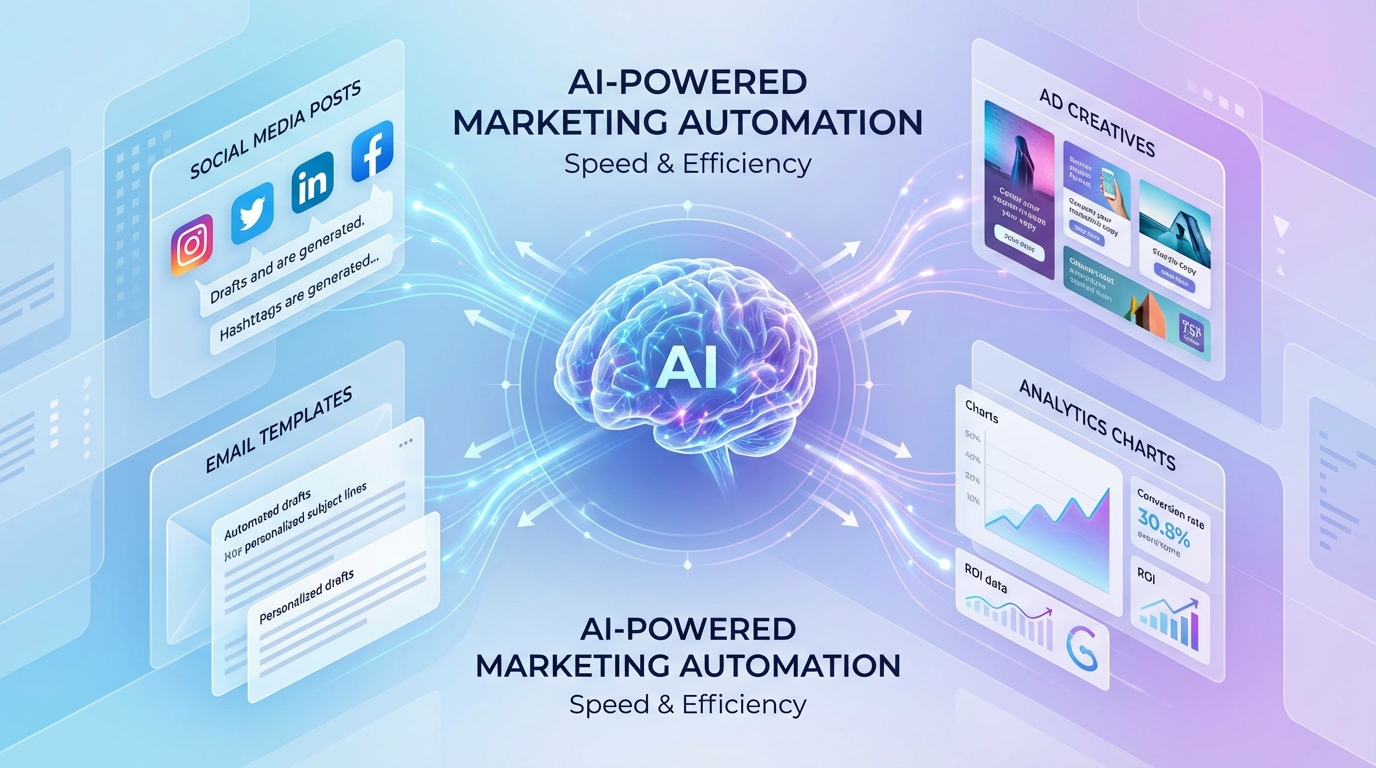
All-in-one platforms consolidate data from every channel—website, social media, email, paid ads—into single dashboards. You see the complete customer journey, understanding exactly which touchpoints drive conversions.
Prescriptive Recommendations
AI doesn't just report metrics—it tells you what to do. Instead of showing "email open rates decreased 5%," it recommends "Test subject lines with personalization tokens" or "Send emails at 2 PM instead of 9 AM based on segment behavior."
Albert.ai, an autonomous AI marketing platform, manages entire campaigns independently, making thousands of micro-optimizations daily. Companies using Albert report 30% higher ROAS on average.
Attribution Modeling
Understanding which marketing touchpoints deserve credit for conversions has always been challenging. AI-powered attribution models analyze the entire customer journey, assigning accurate value to each interaction. This reveals your true top-performing channels and tactics.
Top AI Platforms for Full Campaign Creation
Let's examine the leading all-in-one solutions available in 2025:
HubSpot Marketing Hub with AI
HubSpot integrates content creation, social scheduling, email automation, and analytics with built-in AI assistance. Their AI Content Assistant generates blog posts, social content, and email copy while maintaining brand voice. Best for: Small to medium businesses wanting comprehensive marketing automation.
Salesforce Marketing Cloud with Einstein AI
Salesforce's Einstein AI powers predictive audience segmentation, send-time optimization, and content personalization. It excels at enterprise-level campaign orchestration across multiple touchpoints. Best for: Large enterprises with complex customer journeys.
Simplified (All-in-One Platform)
Simplified combines AI writing, graphic design, video creation, and social media management in one affordable platform. It's specifically designed for small business owners and solo marketers. Best for: Budget-conscious small businesses and startups.
Jasper + Surfer SEO Integration
Jasper's AI writing combined with Surfer SEO's optimization creates content that ranks. Add integrations with design tools and social schedulers for complete campaigns. Best for: Content-focused marketing teams prioritizing SEO.
Benefits of AI-Powered Campaign Creation
The advantages extend far beyond speed:
Dramatic Time Savings
What previously required 3-4 weeks now takes hours or minutes. Forrester Research found that marketing teams using AI platforms save an average of 12.5 hours per week on campaign creation.
Cost Efficiency
You need fewer specialists and fewer tools. One all-in-one platform replaces subscriptions to separate writing, design, scheduling, and analytics tools. Small businesses report 40-60% reduction in marketing software costs.
Consistency Across Channels
AI ensures your messaging remains consistent whether customers encounter your brand on Instagram, email, or paid search. This consistency builds trust and brand recognition.
Data-Driven Decisions
Every recommendation comes from data analysis, not gut feelings. This reduces costly mistakes and improves campaign performance over time.
Scalability
Small teams can execute enterprise-level campaigns. You can test multiple campaign variations simultaneously, something previously reserved for companies with massive budgets.
Risks and Limitations to Consider
Despite tremendous benefits, AI marketing isn't without challenges:
Generic Content Risk
Over-reliance on AI without human oversight can produce content that's technically correct but soulless. Your unique brand voice and authentic stories still require human input. Always review and refine AI-generated content before publishing.
Data Privacy Concerns
AI platforms require access to customer data. Ensure your chosen platform complies with GDPR, CCPA, and other privacy regulations. According to IBM's 2025 Data Breach Report, the average cost of a data breach is $4.88 million—making security paramount.
Learning Curve
All-in-one platforms are powerful but complex. Budget time for team training. Most platforms offer certification programs—invest in them.
Over-Automation Risk
Marketing still requires human creativity and emotional intelligence. AI handles execution brilliantly, but strategic thinking, brand storytelling, and relationship building remain human domains. Use AI as your assistant, not your replacement.
Algorithm Dependency
You're trusting AI algorithms with significant decisions. Understand how your platforms make recommendations. Don't blindly follow AI suggestions—validate them against your market knowledge.
Best Practices for Implementation
Maximize your success with these proven strategies:
Start with Clear Objectives
Define what success looks like before implementing AI tools. Are you aiming to reduce campaign creation time by 50%? Increase ROAS by 25%? Clear metrics guide platform selection and measurement.
Build Comprehensive Brand Guidelines
Create detailed documentation of your brand voice, visual identity, messaging pillars, and tone. The better you train your AI, the better results you'll receive. Include examples of excellent previous content.
Implement Gradually
Don't overhaul everything overnight. Start with one campaign type—perhaps social media—then expand to email, then paid advertising. This allows your team to learn and adapt.
Maintain Human Oversight
Establish review processes. Have team members edit AI-generated content, approve designs, and validate strategic recommendations. The best results come from human-AI collaboration.
Continuously Optimize
AI platforms improve as they learn from your campaigns. Regularly review performance, provide feedback to the system, and refine your inputs based on results.
The Future of AI Marketing Campaigns
The technology continues evolving rapidly. Here's what's emerging:
Multimodal AI Integration
Future platforms will seamlessly work across text, images, video, and audio from single prompts. Imagine describing your campaign once and receiving complete assets for all formats and channels.
Advanced Predictive Capabilities
AI will predict market trends before they fully emerge, allowing proactive rather than reactive campaigns. Early adopters will gain significant competitive advantages.
Voice and Conversational AI
As voice search and AI assistants grow, campaign creation will extend to voice-optimized content and conversational marketing experiences.
Autonomous Campaign Management
AI systems will eventually manage entire campaigns independently—from strategy through execution and optimization—with humans providing only high-level objectives and approval.
Recommended Resources for Deeper Learning
Expand your knowledge with these resources:
- "Marketing Artificial Intelligence" by Paul Roetzer - Comprehensive guide to AI marketing applications
- HubSpot Academy's AI for Marketers Course - Free certification program
- Marketing AI Institute - Weekly newsletter and research reports
- Gartner's Magic Quadrant for Marketing Automation - Annual platform comparisons
- Google's Think with Google - AI marketing case studies and research
Conclusion
The ability to create full marketing campaigns in minutes represents more than efficiency—it's a fundamental competitive advantage. The all-in-one AI content revolution empowers even small marketing teams to execute sophisticated, multi-channel campaigns that previously required enterprise resources. You've learned how AI analyzes customer data, generates comprehensive content, automates deployment, and optimizes performance in real-time.
The technology is proven, accessible, and delivering measurable results across industries. Companies embracing these tools report dramatic improvements in speed, cost-efficiency, and campaign performance. However, success requires thoughtful implementation, proper training, and the right balance between automation and human creativity.
Your next step is clear: evaluate your current campaign creation process, identify bottlenecks, and explore how all-in-one AI platforms can address your specific challenges. The marketing landscape is changing rapidly—those who adapt now will lead their industries tomorrow.
Ready to transform your marketing? Download our free "AI Marketing Campaign Checklist" to start implementing these strategies today. Or schedule a personalized consultation with our AI marketing specialists to discover which platforms best fit your business needs. The revolution is here—will you lead it or follow it?