Introduction
As a business leader, you're constantly seeking the next competitive edge. You've seen AI evolve from a buzzword into a tangible tool with platforms like ChatGPT. But the next leap is already here, and it promises to reshape your marketing efforts from the ground up. We're talking about Contextual RAG Agents and Multi-Agent AI systems. These aren't just incremental improvements; they represent a new paradigm for automation and intelligence. This article will demystify these advanced concepts, showing you exactly how they can create a hyper-efficient, autonomous marketing team that works for you 24/7, driving growth and delighting customers.
Demystifying the Jargon: What Are RAG and Multi-Agent AI?
Before we dive into the marketing applications, let's break down these terms in simple language. Forget the complex technical papers; think of it in terms of building the ultimate marketing team. Every great team needs two things: specialized experts and access to the right information. That's precisely what this technology provides.
First, let's look at Retrieval-Augmented Generation (RAG). Standard AI models have a fixed knowledge base. They know a lot, but they don't know your company's latest sales data or the specific details of a customer's support history. RAG changes that. It gives your AI a library card to your own private, secure data—your CRM, product documentation, customer feedback, and internal knowledge bases. When asked a question, a RAG-powered AI first retrieves the most relevant, up-to-date information from your data and then uses that context to generate a highly accurate and relevant answer. Contextual RAG takes this a step further by deeply understanding the context of the user—who they are, their past interactions, and their likely intent.
Now, enter Multi-Agent AI Systems. Instead of relying on one generalist AI to do everything, a multi-agent system is like your company's org chart, but for AI. You create a team of specialized AI "agents," each with a specific role. You might have a "Data Analyst Agent," a "Content Writer Agent," a "Social Media Agent," and an "Email Campaign Agent." These agents can collaborate, delegate tasks, and work together to achieve complex goals that a single AI could never handle on its own.
How Contextual RAG & Multi-Agent Systems Work Together in Marketing
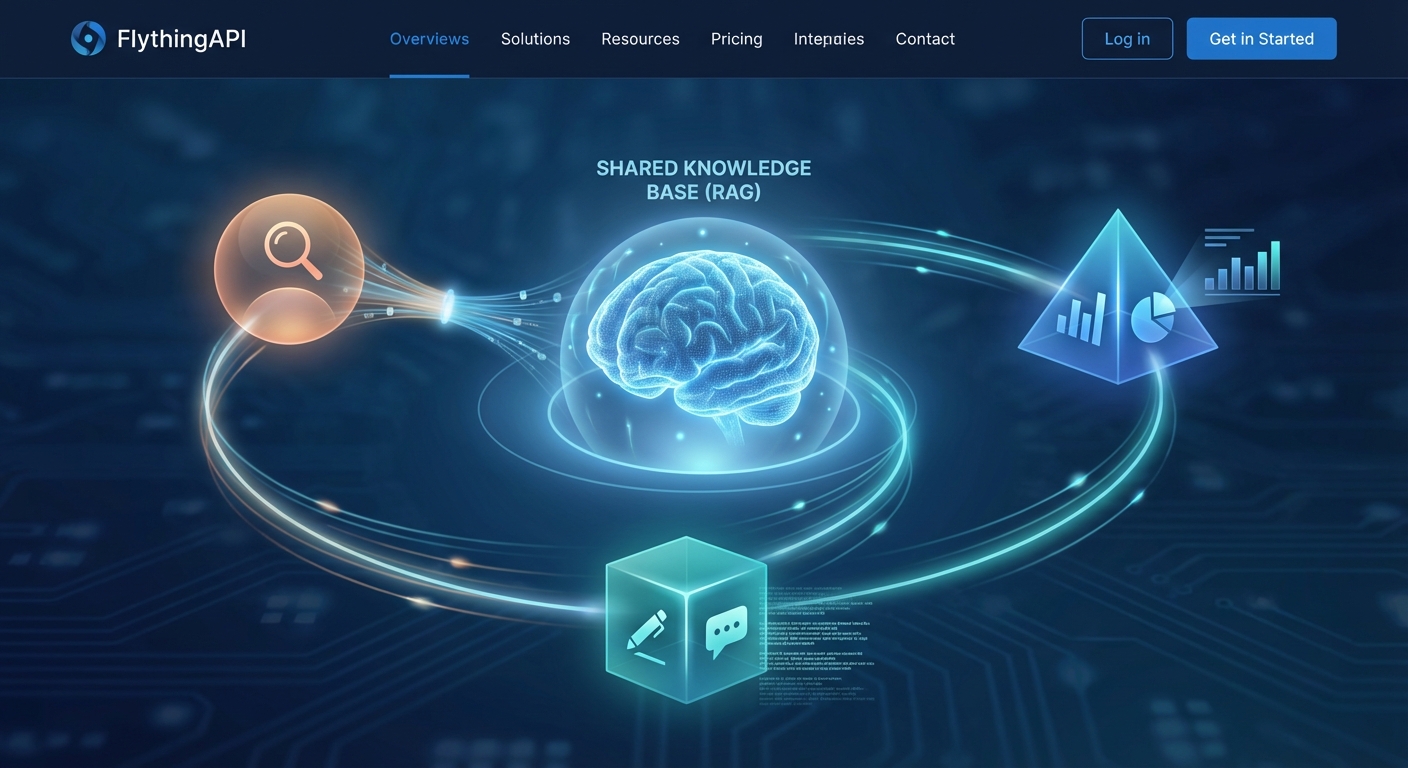
The real magic happens when you combine these two concepts. The Contextual RAG acts as the central brain or the shared knowledge source for your entire team of AI agents. The multi-agent system is the specialized workforce that uses this knowledge to execute tasks with incredible precision and autonomy.
Imagine this scenario: A high-value customer visits your pricing page and then leaves a question in your website's chatbot: "Do your enterprise plans integrate with Salesforce, and are there any case studies for businesses in the logistics sector?"
Here's how a Contextual RAG and Multi-Agent system would handle it, all in a matter of seconds:
- A "Customer Service Agent" fields the initial query.
- It uses the Contextual RAG to instantly identify the user. It pulls their CRM profile, sees they are a high-value prospect from a logistics company, and accesses your internal knowledge base.
- The RAG confirms that, yes, your platform integrates with Salesforce and finds two detailed case studies on logistics clients.
- The Service Agent passes this information to a "Personalization Agent."
- The Personalization Agent tasks a "Content Writer Agent" to draft a friendly, specific response: "Hi [Customer Name], thanks for asking! Yes, our Enterprise Plan has a seamless Salesforce integration. Given you're in the logistics space, you might find these case studies on [Client A] and [Client B] particularly relevant. I've sent a copy to your email at [customer@email.com] for your convenience. Let me know if you'd like to book a demo!"
- An "Email Agent" simultaneously sends the detailed case studies to the customer's inbox.
This isn't just automation. This is an intelligent, coordinated workflow that provides an immediate, personalized, and deeply helpful customer experience—a feat that would typically require several human employees and significantly more time.
Practical Applications for Your Marketing Strategy
This technology isn't science fiction; it's the next frontier for practical marketing execution. Business owners and marketing directors can leverage it to supercharge their strategy.
Hyper-Personalized Email Campaigns: An "Audience Segmentation Agent" can identify micro-segments in your customer base. It then tasks a "Campaign Strategist Agent" to use RAG to find the most relevant products or content for each segment. A "Copywriter Agent" then crafts unique email copy for all 50 segments, which an "Email Deployment Agent" schedules and sends.
Autonomous Content Creation: A "SEO Strategist Agent" monitors trending keywords in your industry. It identifies a high-opportunity topic and checks the RAG to see what content you already have. Noting a gap, it generates a detailed brief and assigns it to a "Blog Writer Agent" to draft a comprehensive article, complete with internal links to relevant product pages.
Proactive Social Media Management: A "Social Listening Agent" detects a tweet complaining about a product issue. It uses RAG to identify the user and pull their order history. It then alerts a "Customer Support Agent," which drafts a public reply saying, "We're sorry you're having trouble, [User Name]. We see your order details and a support ticket has been created. Our team will be in touch shortly." This turns a public complaint into a demonstration of excellent service.
Advanced Lead Nurturing: An "Analytics Agent" flags a user who has visited your pricing page three times and downloaded a whitepaper. It classifies them as a hot lead and passes them to a "Nurturing Agent." This agent uses RAG to find the perfect case study and salesperson for that lead's industry and geography, then tasks an "Email Agent" to send a personalized outreach to book a meeting.
The Tangible Benefits for Your Business
Adopting a Contextual RAG and Multi-Agent approach delivers transformative business value that goes far beyond simple efficiency.
Unprecedented Personalization: The ability to tailor every interaction based on a complete and current understanding of the customer is the holy grail of marketing. A 2023 McKinsey study found that companies that excel at personalization generate 40% more revenue from those activities than average players.
Radical Efficiency: By automating complex, multi-step workflows, these systems free up your human team to focus on high-level strategy, creativity, and relationship-building. This allows you to scale your marketing efforts without scaling your headcount.
Enhanced Decision-Making: AI agents can analyze vast datasets in real-time, providing not just reports but actionable insights. Imagine an agent that alerts you: "Our ad spend on Platform X has seen a 15% drop in conversion rate this week for the 25-34 demographic. I recommend reallocating that budget to Platform Y, which is seeing a 20% increase for the same audience."
Superior Customer Experience: In an always-on world, customers expect immediate and accurate answers. AI agent teams provide 24/7 support and engagement, ensuring no lead is missed and no question goes unanswered for long.
Navigating the Risks and Challenges
While the potential is immense, adopting this technology requires a strategic approach. It's crucial to be aware of the potential hurdles.
Data is the Foundation: A Multi-Agent system is only as smart as the data it can access via its RAG. If your CRM is a mess or your knowledge base is outdated, the AI's performance will be poor. The principle of "garbage in, garbage out" has never been more relevant.
Implementation Complexity: These are not simple, off-the-shelf solutions. Setting up a robust RAG and configuring a team of specialized AI agents requires significant technical expertise and a clear understanding of your business processes.
Cost of Entry: The initial investment can be substantial, encompassing platform costs, data infrastructure upgrades, and the specialized talent needed to manage the system. However, the ROI from increased efficiency and revenue can be significant.
Oversight and Governance: You need a human in the loop. It's essential to have clear controls, monitoring, and override capabilities to ensure the agents are performing as expected and aligned with your brand's voice and business goals.
Getting Started: Your First Steps into Multi-Agent AI
Feeling overwhelmed? Don't be. The journey into advanced AI is a marathon, not a sprint. You can begin taking practical steps today to prepare your business for this new era.
Conduct a Data Audit: The single most important first step. Analyze the state of your core data assets: your CRM, customer support logs, product information, and marketing analytics. Begin the process of cleaning, organizing, and centralizing this data. (For more on this, read our upcoming article: How to Conduct a Data Audit for AI Readiness).
Identify a Pilot Project: Don't try to boil the ocean. Select one specific, high-impact workflow to automate. Good candidates include answering tier-one support questions, qualifying inbound leads, or personalizing welcome email series.
Explore Emerging Platforms: The market for agent-building frameworks and AI orchestration platforms is growing rapidly. Start researching these tools to understand their capabilities and requirements. For deeper technical reading, you can explore resources from institutions like Stanford's Human-Centered AI Institute (HAI).
Invest in Skills: Whether you upskill your current team or hire new talent, you will need people who understand both marketing strategy and AI capabilities. This hybrid talent is key to bridging the gap between the technology's potential and its practical application.
Conclusion: Your New AI-Powered Marketing Team
Contextual RAG Agents & Multi-Agent systems are more than just the next step in AI; they are the foundation for a new way of doing business. By combining a central, context-aware knowledge base (RAG) with a team of specialized, collaborative AI workers (Multi-Agent), you can build an autonomous marketing engine that is more efficient, personalized, and intelligent than ever before. This technology handles the repetitive, data-intensive tasks, allowing your human team to focus on what they do best: strategy, creativity, and building genuine customer relationships. The future of marketing isn't about replacing humans; it's about augmenting them with a powerful AI team that works tirelessly to grow your business.
Ready to explore how an AI-powered team can revolutionize your marketing? Subscribe to our newsletter for weekly insights and case studies, or schedule a free consultation with our AI strategy team to build your roadmap.