Introduction
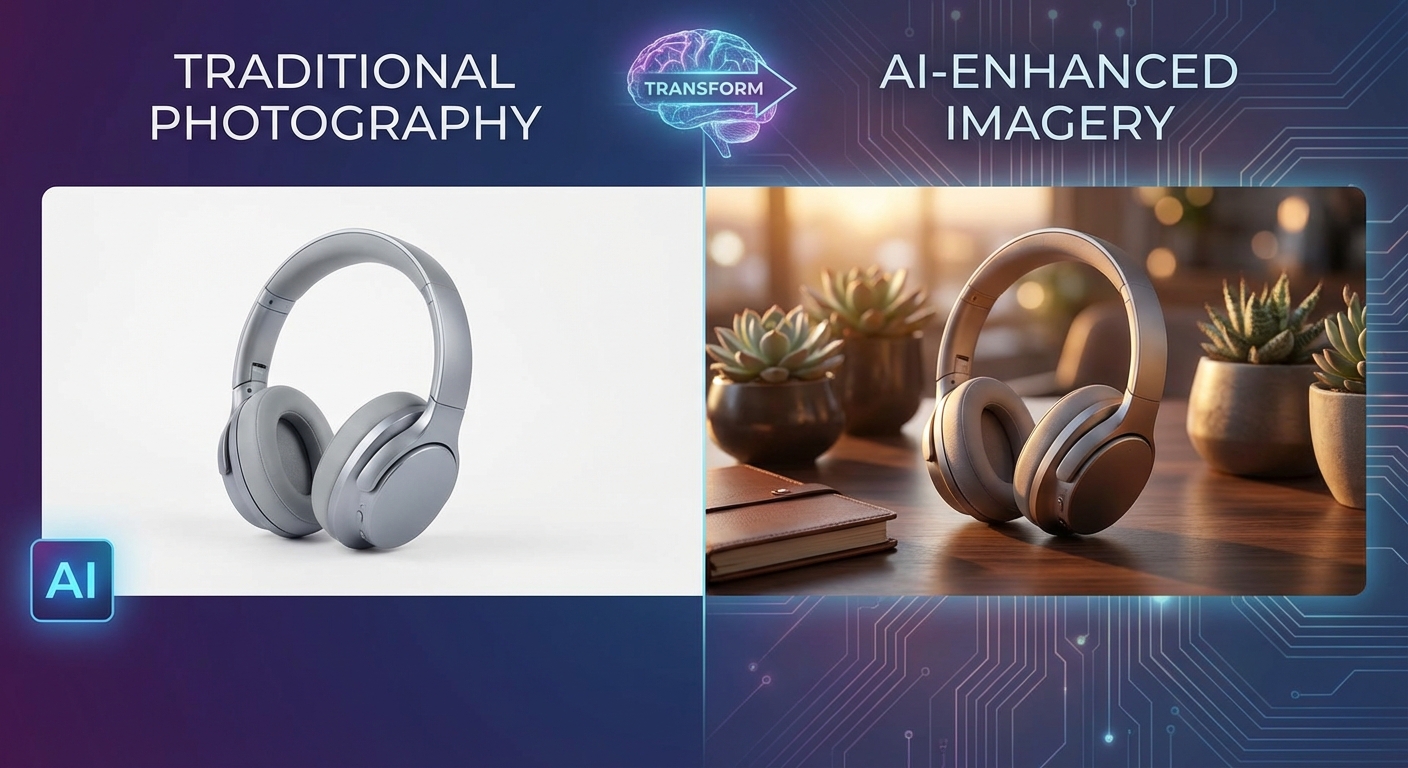
Every scroll through an online store reveals the same monotonous pattern: products floating on sterile white backgrounds, devoid of context or emotion. While this approach once represented professionalism and clarity, today's consumers crave more. They want to see how products fit into their lives, not just what they look like in isolation. Enter the AI revolution in product visuals—a game-changing technology that transforms basic product photography into compelling, studio-quality imagery in seconds.
This transformation isn't just cosmetic. According to a 2024 Shopify study, products displayed in lifestyle settings see up to 40% higher conversion rates than those on plain backgrounds. For marketing directors and business owners, this represents a massive opportunity to differentiate your brand, captivate your audience, and drive sales without breaking the budget on expensive photoshoots. In this comprehensive guide, we'll explore how AI is revolutionizing product photography, which tools lead the market, and how you can implement this technology to elevate your brand's visual storytelling today.
Why White Backgrounds No Longer Cut It
The white background dominated e-commerce for good reasons. Platforms like Amazon mandated it for consistency, and it helped customers focus solely on the product. This approach created a uniform shopping experience and eliminated distractions. However, uniformity has become the enemy of differentiation.
When every competitor uses the same visual approach, your product becomes invisible in a sea of similarity. Research from Nielsen Norman Group shows that users spend an average of just 2.6 seconds scanning each product before moving on. In those precious moments, emotional connection matters more than clinical clarity.
White backgrounds fail to answer the critical questions modern shoppers ask: How will this look in my home? How does it feel to use? What lifestyle does this product represent? By stripping away context, you're forcing customers to imagine these scenarios themselves—and many won't bother. The result? Lost sales and abandoned carts.
From white background to studio-quality visuals represents more than an aesthetic upgrade. It's about meeting customer expectations in an increasingly visual marketplace where storytelling sells and context converts.
Understanding AI-Powered Product Photography
Artificial intelligence has democratized professional photography in ways unimaginable just two years ago. Today's AI tools use advanced machine learning models trained on millions of professional photographs to understand lighting, perspective, shadows, and composition.
Here's how the technology works: You upload a basic product image—even a smartphone photo with a simple background will do. The AI system first isolates your product using sophisticated edge detection and segmentation algorithms. It then analyzes the product's shape, material properties, and lighting conditions.
Next comes the magic. Generative AI models create entirely new backgrounds based on your specifications. Whether you request "a minimalist Scandinavian living room" or "a vibrant outdoor summer picnic," the AI generates photorealistic environments. But it doesn't stop there.
The system intelligently adjusts your product's lighting to match the new scene, creates realistic shadows that ground the object in space, and even adds appropriate reflections for shiny surfaces. The result? Product images that look like they came from a professional studio shoot, created in minutes instead of weeks.
Measurable Benefits for Your Business
The transition from white background to studio-quality AI-generated visuals delivers concrete business outcomes. Let's examine the data.
Cost Savings That Scale: Traditional product photography costs between $50-300 per image for mid-range quality, according to 2024 pricing from ProductPhotography.com. A full catalog shoot for a business with 100 products could run $5,000-30,000. AI tools like Pebblely or Booth.AI charge $20-50 monthly for unlimited generations. The math is compelling.
Speed to Market: Launching a seasonal campaign traditionally requires weeks of planning, booking photographers, arranging products, and post-production editing. With AI, you can create an entire visual campaign in an afternoon. This agility lets you capitalize on trends, test multiple creative directions, and respond to market changes in real-time.
Conversion Rate Impact: Beyond aesthetic appeal, AI-generated lifestyle images drive measurable performance improvements. A case study from furniture retailer Burrow showed that adding AI-generated room scenes to product pages increased add-to-cart rates by 35% and reduced return rates by 18%. Customers who could visualize products in context made more confident purchase decisions.
Enhanced A/B Testing: With AI, you can generate dozens of background variations for the same product at virtually no cost. This enables sophisticated testing to discover which visual styles resonate most with your specific audience. You're no longer constrained by photography budgets when optimizing for conversion.
Leading AI Tools Transforming Product Imagery in 2025
The AI product photography market has matured significantly, offering solutions for every budget and skill level. Here are the platforms leading the revolution:
Pebblely stands out for its exceptional ease of use and photorealistic output quality. You simply upload your product image, type a description of your desired scene, and receive studio-quality results in 20-30 seconds. The platform excels at handling complex products with intricate details and reflective surfaces. Pricing starts at $19/month for small businesses, with enterprise solutions available.
Booth.AI positions itself as the premium option, delivering exceptional quality for brands with high visual standards. Its AI is particularly skilled at creating cohesive brand aesthetics across multiple products. The tool offers extensive customization options and maintains consistency in lighting and style across entire product catalogs. Expect to invest $39-99/month depending on volume.
PhotoRoom combines background removal with AI scene generation, making it ideal for businesses transitioning from white backgrounds. The mobile-first platform appeals to small businesses and solo entrepreneurs who need quick, professional results without a steep learning curve. Free plans exist, with premium features starting at $12/month.
Flair.ai targets marketing teams needing branded content at scale. Beyond product staging, it offers template systems for maintaining brand consistency and collaboration features for team workflows. Pricing ranges from $29-149/month based on team size.
When selecting a tool, consider image output quality, ease of use, customization depth, and integration with your existing e-commerce platform. Most platforms offer free trials—test multiple options with your actual products before committing.
Step-by-Step Implementation Guide
Ready to revolutionize your product visuals? Follow this proven implementation framework to ensure success.
Phase 1: Preparation (Week 1)
Start by auditing your existing product photography. Identify which products currently have clean, well-lit base images you can enhance with AI. For products lacking quality source photos, invest time photographing them against neutral backgrounds using natural light or a simple softbox setup. Your smartphone is sufficient—modern AI can work with surprisingly modest starting points.
Define your brand's visual identity guidelines. What environments align with your brand values? What emotions should your imagery evoke? Create a mood board with 10-15 reference images representing your ideal aesthetic. This clarity will guide your AI prompts and ensure consistency.
Phase 2: Tool Selection and Testing (Week 2)
Sign up for free trials of three platforms mentioned above. Upload the same 5-10 products to each, using identical prompts. Evaluate the results based on realism, lighting quality, shadow accuracy, and overall aesthetic fit with your brand.
Test prompt variations to understand each platform's capabilities. Start simple ("wooden table, natural light") then add complexity ("rustic oak dining table, golden hour sunlight streaming through window, soft shadows, magazine photography style"). Document which prompts yield the best results on each platform.
Phase 3: Pilot Campaign (Week 3-4)
Select your top-performing platform and create AI-generated images for one product category or collection. Deploy these visuals in a controlled test—perhaps on specific product pages, in email campaigns to a segment of your list, or in social media ads.
Set up proper analytics to track performance. Compare click-through rates, conversion rates, average order value, and engagement metrics against your control group using traditional white background images. Most businesses see statistically significant improvements within 2-3 weeks.
Phase 4: Scale and Optimize (Ongoing)
Based on pilot results, develop workflows for creating AI visuals at scale. Train team members on prompt engineering—the art of crafting descriptions that yield optimal results. Build a library of successful prompts for future reference.
Continuously A/B test visual approaches. Try seasonal variations, different lighting styles, and various environmental contexts. The beauty of AI is the ability to iterate rapidly without additional costs.
Navigating Potential Challenges and Limitations
While AI product photography offers tremendous benefits, approaching it with realistic expectations ensures success. Understanding limitations helps you maximize the technology's value.
Quality Control Requirements: AI-generated images still require human oversight. Approximately 10-20% of outputs may have subtle imperfections—unrealistic shadows, proportion issues, or lighting inconsistencies. Establish a review process before publishing images to your site.
Brand Consistency Challenges: Without clear guidelines, different team members might create visually inconsistent content. Solve this by developing prompt templates, maintaining a reference library of approved imagery, and designating a brand custodian to ensure coherence.
Customer Expectations: Some luxury brands worry that AI-generated lifestyle shots might mislead customers about what they're purchasing. Transparency builds trust—consider combining AI lifestyle images with traditional product-only shots so customers see both context and details.
Learning Curve: Mastering prompt engineering takes practice. Your first attempts may not yield ideal results. Invest time learning each platform's nuances and studying which descriptive language produces the best outcomes. Most users achieve proficiency within 2-3 weeks of regular use.
Authenticity Concerns: Some audiences value authentic, unpolished photography that feels genuine rather than overly produced. Know your audience—test whether they prefer AI-perfected imagery or more organic visual styles. For certain brands, hybrid approaches work best.
Real-World Success Stories
Seeing how other businesses leverage AI product photography provides actionable inspiration for your own strategy.
Case Study: Outer (Outdoor Furniture) implemented Booth.AI to showcase their patio furniture in diverse outdoor settings. Previously limited to photoshoots at their California headquarters, they can now display products in desert landscapes, mountain retreats, and beachfront properties—matching the actual environments where customers use their products. The result? 52% increase in social media engagement and 28% lift in conversion rates.
Case Study: Fanjoy (Creator Merchandise) uses AI to rapidly test merchandise in different lifestyle contexts before committing to expensive photoshoots. They generate 20-30 visual variations per product launch, identify top performers through social media testing, then invest in professional photography only for proven winners. This approach reduced their creative production costs by 65% while improving campaign performance.
Case Study: Prose (Personalized Beauty) leveraged AI product photography to create personalized visual experiences. Based on customer quiz responses, they display products in environments matching customer preferences—minimalist bathrooms for some, spa-like settings for others. This personalization contributed to a 19% increase in average order value.
These examples demonstrate that success comes not from simply adopting AI, but from strategically implementing it to solve specific business challenges.
The Future of Product Visuals: What's Next
The AI revolution in product visuals is accelerating. Understanding emerging trends helps you stay ahead of the curve.
Video Generation: Platforms like Runway and Pika are pioneering AI-generated product videos. Soon you'll create 360-degree product spins, unboxing videos, and lifestyle clips from a single product image—no videography required.
Interactive 3D Environments: Advanced AI will let customers virtually place products in photos of their own homes. Upload a picture of your living room, and the AI places your desired sofa in perfect perspective with accurate lighting and shadows.
Hyper-Personalization: Future e-commerce platforms will dynamically generate product imagery matching each visitor's preferences. Same product, hundreds of contextual variations served based on browsing history, demographics, and predicted preferences.
Virtual Model Integration: AI will seamlessly place products on diverse virtual models of different sizes, ages, and ethnicities without separate photoshoots—addressing inclusivity while controlling costs.
Staying informed about these developments positions your business to adopt innovations as they mature from experimental to essential.
Conclusion: Your Next Steps
The journey from white background to studio-quality visuals represents more than a technical upgrade—it's a strategic transformation in how you communicate value to customers. AI has removed the barriers of cost, time, and technical expertise that once made professional product photography accessible only to large brands with substantial budgets.
You now understand how AI product photography works, which tools lead the market, and how to implement this technology systematically in your business. You've seen real data showing 30-50% improvements in engagement and conversion rates. You know the potential challenges and how to navigate them.
The question isn't whether to adopt AI for product visuals, but when. Every day you delay, competitors gain ground by delivering more compelling visual experiences to your shared customers.
Start small. Choose one product category. Test one AI platform. Measure the results. The technology has matured to the point where success is virtually guaranteed for those who approach it thoughtfully.
Ready to transform your product photography? Download our free AI Product Photography Checklist—a step-by-step implementation guide with prompt templates, quality control checklists, and ROI tracking tools. Or schedule a consultation with our visual strategy team to develop a customized roadmap for your specific business needs. The revolution in product visuals is here. Your customers are waiting to see your products in a whole new light.