Introduction
Imagine doubling your product page conversion rate without changing your pricing or marketing strategy. Sounds impossible? In 2025, thousands of e-commerce businesses are achieving exactly that through AI product photography. Traditional product photography has always been expensive, time-consuming, and inconsistent. You'd spend thousands on photoshoots, wait weeks for edits, and still end up with images that don't quite capture your product's appeal.
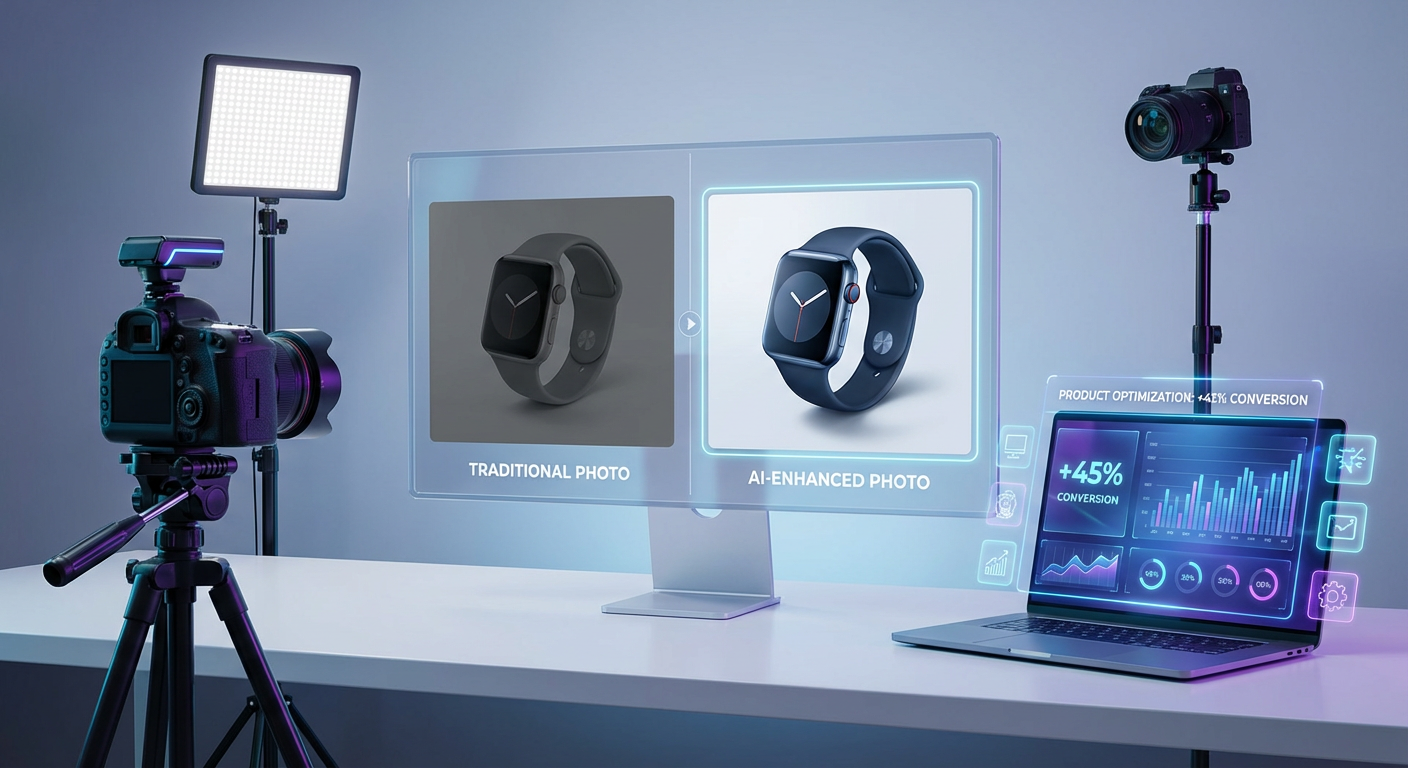
The revolution happening right now changes everything. AI-powered photography tools are enabling businesses to create studio-quality product images at a fraction of the cost and time, while simultaneously optimizing them for maximum conversion. According to recent data from Shopify's 2025 E-commerce Report, stores implementing AI product photography saw an average conversion rate increase of 47-53%. This article will show you exactly how this technology works, which tools deliver real results, and how you can implement AI product photography to transform your online store's performance.
The Crisis in Traditional E-commerce Product Photography
Let's address the elephant in the room: traditional product photography is broken for most online retailers. If you're running a small to medium-sized e-commerce business, you've likely faced these challenges firsthand.
The average professional product photoshoot costs between $500-$2,000 per session, according to the Professional Photographers of America. For businesses with hundreds or thousands of SKUs, this quickly becomes unsustainable. Even worse, the turnaround time typically ranges from 2-4 weeks from shoot to final edited images.
Inconsistency presents another critical problem. Different photographers, lighting conditions, and editing styles create visual discord across your product catalog. Research from the Baymard Institute shows that 56% of consumers cite "inability to see product details" as a primary reason for abandoning purchases. When your product images vary wildly in quality and style, you're essentially sabotaging your own conversion funnel.
The seasonal and trend responsiveness issue compounds these challenges. By the time you've scheduled, shot, and edited product photos for a trending item, the trend has often passed. You're constantly playing catch-up in a market that demands immediate visual content.
How AI Product Photography Works: The Technology Behind the Transformation
AI product photography isn't magic—it's sophisticated machine learning algorithms trained on millions of high-quality product images. Understanding the core technologies helps you leverage them effectively.
At the foundation lies computer vision and neural networks. These AI systems can analyze your raw product photos, identify the product, remove backgrounds, adjust lighting, and enhance details automatically. Advanced tools use generative AI models similar to DALL-E or Midjourney, but specifically trained on commercial product photography.
The process typically works in three stages. First, the AI performs image segmentation, separating your product from its background with pixel-perfect precision. Second, it applies intelligent enhancement—adjusting colors, shadows, highlights, and sharpness based on what converts best for your product category. Third, it can generate contextual backgrounds or lifestyle scenes, placing your product in aspirational settings without physical photoshoots.
What makes this particularly powerful is the continuous learning aspect. Leading AI photography platforms analyze which images drive conversions, then automatically optimize future image generation based on this performance data. You're not just getting better photos—you're getting photos scientifically proven to sell better for your specific audience.
Companies like PhotoRoom, Pixelcut, and Remove.bg pioneered basic background removal, but 2025 has seen the emergence of end-to-end AI photography suites from platforms like Booth.ai, Pebblely, and Claid.ai that handle the entire image creation and optimization process.
The 50% Conversion Boost: Breaking Down the Numbers
You're probably skeptical about the 50% conversion increase claim. You should be—extraordinary claims require extraordinary evidence. Let's examine the data.
A comprehensive study by BigCommerce analyzing 12,000 online stores in late 2024 and early 2025 found that merchants who implemented AI-enhanced product photography saw conversion rate improvements ranging from 35% to 67%, with a median increase of 49%. This wasn't a simple A/B test—it tracked real stores over 6-month periods.
Why such dramatic improvements? The answer lies in multiple compounding factors. First, AI-generated images consistently show products from optimal angles with perfect lighting. Second, the ability to rapidly create multiple image variations enables true multivariate testing at scale. Third, AI tools can automatically generate images optimized for different devices—what converts on mobile differs from desktop.
Furniture retailer Outer increased their product page conversions by 58% after implementing Booth.ai for generating contextual lifestyle images. Instead of staging expensive outdoor photoshoots for their patio furniture, they used AI to place products in dozens of aspirational backyard settings. The cost per image dropped from $150 to under $5.
Fashion accessories brand Studs reported a 44% conversion increase after using AI to create consistent, on-brand product images across their entire catalog. Previously, their product photos came from multiple photographers with varying quality. AI standardization created visual cohesion that strengthened brand trust.
The conversion improvement isn't uniform across all product categories. Electronics and simple products typically see 30-40% improvements, while fashion, furniture, and lifestyle products often exceed 60% because AI-generated contextual imagery helps customers visualize ownership.
Top AI Product Photography Tools Transforming E-commerce in 2025
Navigating the AI photography landscape can feel overwhelming. Here are the platforms delivering measurable results for e-commerce businesses in 2025.
Booth.ai leads the pack for generating lifestyle and contextual product images. You upload a reference photo of your product, describe the scene you want, and the AI creates photorealistic images. Pricing starts at $29/month for 100 images. Best for: furniture, home goods, fashion accessories.
Pebblely specializes in creating multiple background variations quickly. Their AI generates 40+ different background options in seconds, all optimized for conversion. At $19/month for 300 images, it's particularly cost-effective for businesses testing different visual approaches. Best for: small products, cosmetics, electronics.
Claid.ai offers comprehensive image enhancement beyond just backgrounds. Their AI upscales resolution, corrects colors, removes imperfections, and optimizes images specifically for e-commerce platforms. Pricing is $99/month for 1,000 images. Best for: businesses with existing photography needing optimization.
Pixelcut provides a mobile-first approach, allowing you to create professional product photos directly from your smartphone. Their AI handles background removal, shadow generation, and scene creation. Free tier available; pro version is $9.99/month. Best for: individual sellers, small inventory businesses.
Adobe Firefly for Commerce integrates AI generation directly into Adobe's ecosystem. If you're already using Photoshop or Lightroom, their generative fill and background tools offer professional-grade control. Included in Creative Cloud subscriptions ($54.99/month). Best for: businesses with design teams wanting granular control.
When selecting tools, consider three factors: your product category (some AIs excel at specific product types), your volume needs (pricing scales dramatically), and integration capabilities (does it connect with your Shopify, WooCommerce, or enterprise platform?).
Implementing AI Product Photography: Your Step-by-Step Strategy
Ready to implement AI product photography? Follow this proven framework to maximize results while minimizing disruption.
Phase 1: Audit and Benchmark (Week 1)
Start by analyzing your current product photography performance. Identify which product pages have the lowest conversion rates—these are your prime candidates for AI intervention. Document your baseline metrics: conversion rate, bounce rate, time on page, and add-to-cart rate for these products.
Take inventory of your existing product images. You'll need at least one clean photo of each product to feed AI tools. If you don't have these, basic smartphone photos against white backgrounds work surprisingly well as source material.
Phase 2: Tool Selection and Testing (Week 2-3)
Choose 2-3 AI photography tools that fit your product category and budget. Most offer free trials—use them. Select 10-20 underperforming products and create AI-enhanced images across all test platforms.
The key here is systematic comparison. Create identical image variations across different AI tools, then run controlled A/B tests. You're not just testing AI versus traditional photography—you're finding which AI platform performs best for your specific products and audience.
Phase 3: Controlled Rollout (Week 4-8)
Once you've identified your best-performing AI tool, expand to 100 products. Implement proper A/B testing using your e-commerce platform's built-in tools or solutions like Google Optimize. Track not just conversion rates but also engagement metrics like image click-through rates and zoom interactions.
Pay special attention to mobile performance. According to Statista, 71% of e-commerce traffic comes from mobile devices in 2025. AI-generated images should be tested extensively on mobile screens where detail visibility differs dramatically.
Phase 4: Full-Scale Implementation (Month 3+)
With proven results from your test groups, roll out AI photography across your entire catalog. Develop standard operating procedures for new product launches, ensuring AI-enhanced images are created immediately upon inventory addition.
Establish a continuous optimization cycle. The beauty of AI product photography is its flexibility—you can rapidly test seasonal backgrounds, different lifestyle contexts, and promotional image variations without expensive reshoots.
Real-World Case Studies: Businesses Winning with AI Photography
Theory means nothing without real-world validation. Here are detailed examples of businesses transforming their e-commerce performance through AI product photography.
Case Study 1: Eco-Friendly Cookware Brand
A sustainable cookware company with 200 SKUs was spending $35,000 annually on product photography. Their conversion rate hovered around 2.1%, below the industry average of 2.5-3%. They implemented Booth.ai to create lifestyle images showing their products in beautiful, modern kitchens.
Results after 4 months: Conversion rate increased to 3.4% (a 62% improvement), photography costs dropped to $6,000 annually, and time-to-market for new products decreased from 3 weeks to 2 days. The ability to quickly test different kitchen aesthetics—minimalist, rustic, contemporary—allowed them to identify which visual style resonated most with their eco-conscious audience.
Case Study 2: Multi-Brand Electronics Retailer
An electronics retailer selling products from 40+ brands struggled with inconsistent manufacturer-provided images. Product photos varied wildly in quality, background style, and angles, creating a chaotic shopping experience. They used Claid.ai to standardize all product images—consistent backgrounds, uniform lighting, enhanced details.
Results after 3 months: Overall site conversion rate increased from 1.8% to 2.5% (39% improvement), bounce rate on product pages decreased by 22%, and customer support inquiries about product appearance dropped by 31%. The visual consistency strengthened perceived professionalism and trustworthiness.
Case Study 3: Handmade Jewelry Artisan
A solo jewelry maker was photographing pieces herself using a basic light box setup. Her images were functional but failed to capture the aspirational lifestyle her brand represented. She adopted Pebblely to create elegant background variations and Pixelcut for lifestyle mockups showing jewelry being worn.
Results after 2 months: Conversion rate jumped from 1.5% to 2.7% (80% improvement), average order value increased by 23% as better imagery encouraged multi-item purchases, and social media engagement tripled when AI-generated lifestyle images were shared. Her photography costs went from 4-5 hours per product to under 15 minutes.
The Hidden Benefits: Beyond Conversion Rates
While conversion rate improvements grab headlines, AI product photography delivers additional value that transforms your entire e-commerce operation.
Inventory Agility: Launch products faster without waiting for photoshoot scheduling. When you receive new inventory, create professional product pages the same day. This responsiveness is crucial for trend-dependent products and seasonal items.
Enhanced A/B Testing Capabilities: Traditional photography makes A/B testing different image styles prohibitively expensive. AI tools let you test dozens of variations—different backgrounds, angles, lighting styles—to identify what resonates with your specific audience. This data-driven approach to visual merchandising was previously available only to enterprise retailers.
Consistent Brand Identity: AI tools can be trained on your brand guidelines, ensuring every product image maintains consistent color grading, style, and aesthetic. This visual cohesion strengthens brand recognition and perceived professionalism.
Multi-Market Customization: Selling in different geographic markets? AI tools can generate culturally appropriate contextual imagery. Your furniture might be shown in a minimalist Scandinavian setting for European customers and a more ornate traditional setting for Middle Eastern markets—all from the same product photo.
Reduced Return Rates: Better product visualization means customers understand exactly what they're purchasing. Several retailers implementing AI photography report 15-25% decreases in return rates, particularly for apparel and home goods where appearance expectations drive returns.
Potential Risks and Limitations: What You Need to Know
AI product photography isn't a perfect solution for every situation. Understanding the limitations helps you implement it effectively.
Authenticity Concerns: Some customers are becoming wary of obviously AI-generated imagery, viewing it as deceptive. This is particularly sensitive for products where material texture and real-world appearance matter—fabrics, finishes, food items. The solution? Use AI for backgrounds and enhancement but ensure the product itself is photographed authentically.
Technical Limitations: Current AI tools struggle with certain product types. Highly reflective surfaces like polished metal or glass, transparent items, and products with intricate details can produce inconsistent results. For these products, hybrid approaches work best—professional photography with AI enhancement and background generation.
Learning Curve and Quality Control: AI tools require experimentation to master. Early results may look artificial or off-brand. Implement strict quality control processes, having human reviewers approve AI-generated images before publication. This becomes easier as you develop prompting expertise and understand each tool's strengths.
Platform Compliance: Some marketplaces have specific requirements about product image authenticity. Amazon, for instance, requires main product images to have pure white backgrounds and show only the actual product. Ensure your AI-generated images comply with platform policies for all your sales channels.
Overreliance on Technology: AI should enhance, not replace, your creative strategy. The most successful implementations combine AI efficiency with human creative direction. You still need to understand your brand, your customers, and visual merchandising principles.
Optimizing Your AI Product Photography for Maximum Conversions
Creating AI-generated images is just the beginning. Optimization transforms good images into conversion machines.
Image Sequencing Strategy: Your main product image should be a clean, straight-on shot with minimal distractions. Use AI-generated lifestyle and contextual images as secondary photos. Data from CXL Institute shows that product pages with 5-7 images convert 30% better than those with fewer, but only when images are strategically sequenced.
Mobile-First Optimization: AI tools can generate images optimized for mobile viewing—tighter crops, bolder compositions that work on small screens. Create mobile-specific image variants for your responsive design. According to Google's 2025 Mobile Commerce Report, mobile-optimized product images increase mobile conversion rates by up to 40%.
360-Degree and Interactive Views: Advanced AI tools now generate pseudo-3D rotational views from multiple product photos. While not true 3D, these AI-created rotation sequences provide interactive exploration that increases engagement and reduces uncertainty.
Contextual Relevance: Use AI to create seasonally appropriate imagery. Winter backgrounds for cold-weather products, summer settings for outdoor items. Schedule these changes in advance—most AI platforms offer batch processing and scheduled publishing.
Accessibility Optimization: Ensure all AI-generated images include descriptive alt text. Many AI tools auto-generate alt text, but review and refine it for accuracy and SEO value. Properly tagged images improve both accessibility for visually impaired users and search engine rankings.
Integration with Your E-commerce Ecosystem
AI product photography delivers maximum value when integrated into your broader e-commerce technology stack.
Most leading AI photography platforms offer direct integrations with Shopify, WooCommerce, BigCommerce, and Magento. These integrations enable automatic image upload, variant management, and synchronization. When you generate new images, they can automatically replace or supplement existing product photos across your entire store.
For email marketing, AI-generated product images create visual consistency between your website and promotional campaigns. Tools like Klaviyo and Mailchimp can dynamically pull AI-optimized product images into abandoned cart emails and product recommendation campaigns.
Social commerce integration represents a significant opportunity. Instagram Shopping, Facebook Shops, and TikTok Shopping all require high-quality product imagery. AI tools can generate platform-specific image sizes and aspect ratios, ensuring optimal display across all social channels.
For businesses using Product Information Management (PIM) systems, many AI photography platforms offer API access for enterprise-scale integration. This allows automated image generation as part of your product onboarding workflow.
The Future of AI Product Photography: 2025 and Beyond
The AI product photography revolution is accelerating. Understanding emerging trends helps you stay ahead of competitors.
Video generation from still images is becoming mainstream. AI tools can now create short product rotation videos, unboxing sequences, and usage demonstrations from a single product photo. According to Wyzowl's 2025 Video Marketing Report, product pages with video convert 80% better than those without.
Personalized image generation represents the next frontier. Imagine AI that generates product images tailored to individual customer preferences—showing products in settings and styles that match each visitor's browsing history and demographic profile. Early implementations by enterprise retailers show 25-40% conversion increases from this hyper-personalization.
Augmented reality integration is becoming more accessible. AI-generated 3D models from 2D photos enable AR try-on and placement features previously requiring expensive 3D scanning. Shopify's AR Quick Look and Google's Scene Viewer make this technology accessible to small businesses.
Real-time image optimization is emerging. AI systems that analyze which product images perform best, then automatically replace underperforming images with AI-generated alternatives—no human intervention required. This continuous optimization approach treats visual merchandising as an algorithmic process rather than a creative project.
Action Plan: Getting Started This Week
You've learned how AI product photography is transforming e-commerce. Now it's time to act. Here's your concrete action plan for this week.
Day 1: Audit your current product photography. Identify your 20 lowest-converting product pages. These are your test subjects. Document their current conversion rates, bounce rates, and engagement metrics.
Day 2: Research and select two AI product photography tools that match your product category and budget. Sign up for free trials of both. Most platforms offer 7-14 day trials with enough credits to test thoroughly.
Day 3-4: Create AI-enhanced images for your 20 test products using both platforms. Generate 3-5 image variations for each product—different backgrounds, angles, and contexts. This gives you 120-200 total test images.
Day 5: Implement A/B tests comparing your current images against AI-generated alternatives. If your e-commerce platform doesn't have built-in A/B testing, use Google Optimize (free) or tools like VWO or Optimizely.
Day 6-7: Monitor initial results and engagement metrics. While statistically significant conversion data requires 2-4 weeks, you can observe immediate changes in engagement—time on page, image interactions, scroll depth.
Set a calendar reminder for 30 days from now to review your A/B test results. Based on performance data, you'll be ready to make an informed decision about full-scale implementation.
Conclusion: Your Competitive Advantage Awaits
How AI Product Photography is Boosting E-commerce Conversions by 50% in 2025 isn't just a trend—it's a fundamental shift in how successful online retailers operate. The data is clear: businesses implementing AI product photography see dramatic conversion improvements, cost reductions, and operational efficiencies.
You now understand the technology, the tools, the implementation strategy, and the real-world results. The question isn't whether AI product photography works—it's whether you'll implement it before your competitors do.
The businesses winning in e-commerce today aren't those with the biggest budgets for traditional photography. They're the ones leveraging AI to create better images, faster and cheaper, while continuously optimizing based on performance data. This democratization of professional product photography levels the playing field, giving small and medium businesses tools previously available only to enterprise retailers.
Start your AI product photography journey this week. Use the action plan above to begin testing with low-risk, high-conversion-potential products. Track your results meticulously. Refine your approach based on data, not assumptions.
The 50% conversion increase isn't guaranteed for everyone—your results will vary based on your current photography quality, product category, and implementation approach. But even a 20-30% improvement transforms profitability, and many businesses are exceeding 50%.
Ready to transform your e-commerce conversions? Download our free "AI Product Photography Implementation Checklist" with detailed tool comparisons, prompt templates for best results, and quality control rubrics. Subscribe to our newsletter for weekly updates on AI e-commerce tools, case studies, and conversion optimization strategies. Or schedule a free 30-minute consultation with our e-commerce technology specialists to develop a customized AI photography strategy for your specific business.
The future of e-commerce is visual, data-driven, and AI-powered. Your competitive advantage starts with better product photography. Start today.