Introduction
In the visually saturated world of Pinterest, simply creating beautiful Pins is no longer enough. With over 500 million active users searching for inspiration and products, the platform is a goldmine for businesses, but cutting through the noise requires immense effort. How can you consistently create, test, and optimize content at scale? The answer lies in AI Pinterest Marketing. This guide will provide you, the forward-thinking marketing director or business owner, with a comprehensive roadmap to leveraging artificial intelligence. You will learn how to automate tedious tasks, uncover powerful insights, and ultimately turn visual discovery into measurable revenue, transforming your Pinterest from a creative outlet into a strategic growth engine.
What is AI Pinterest Marketing and Why Does It Matter?
AI Pinterest Marketing refers to the use of artificial intelligence tools and algorithms to enhance and automate your marketing strategy on the platform. It moves beyond simple scheduling, incorporating machine learning to handle complex tasks like trend prediction, content creation, audience segmentation, and performance analysis. Think of it as having a data scientist, content creator, and strategist working for you 24/7.
Why is this a game-changer? The scale of Pinterest is immense. Users have saved over 240 billion Pins, creating a massive dataset of human intent and interest. For a human marketer, analyzing this data is impossible. AI, however, thrives on it. It can identify subtle patterns and emerging trends long before they become mainstream. According to 2025 market analysis, brands using AI in their social media strategy see up to a 40% increase in engagement and a 25% higher conversion rate, because they can connect with users on a much deeper, more personal level. For a platform where 97% of top searches are unbranded, this ability to predict user needs is your single greatest advantage.
How AI Revolutionizes Your Pinterest Strategy
Integrating AI isn't just about doing things faster; it's about doing them smarter. It fundamentally shifts your approach from reactive to predictive, allowing you to be more strategic and effective in every aspect of your Pinterest presence.
AI-Powered Trend Analysis and Keyword Research
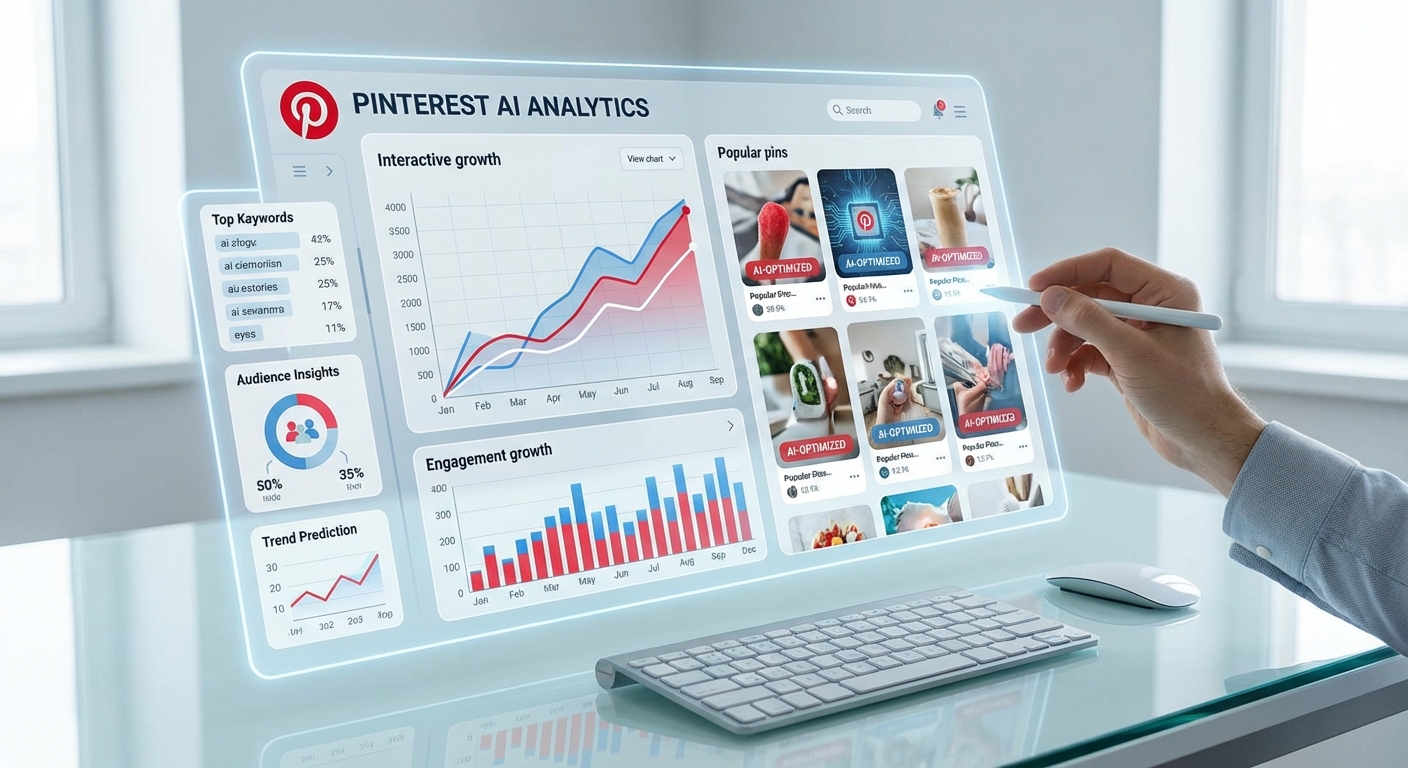
AI tools can sift through millions of Pins, boards, and search queries in real time to identify breakout trends. Imagine your home decor business getting an alert that searches for "biophilic office design" are up 300% this month. An AI tool can not only spot this trend but also analyze the top-performing Pins for that keyword, showing you the dominant color palettes, Pin formats (static vs. video), and description styles. This allows you to create highly relevant content that meets a demonstrated user interest, rather than guessing what might work.
Hyper-Personalization of Content and Ads
Pinterest's algorithm is already a powerful AI designed to personalize the user's home feed. By layering your own AI strategy on top, you can achieve an even greater level of personalization. AI helps you analyze your follower demographics, their pinning behavior, and their engagement history to create detailed audience personas. You can then target these specific segments with custom-made content. For example, a fashion brand can show Gen Z users Pins featuring sustainable streetwear, while targeting millennial followers with Pins about timeless capsule wardrobes, all automated based on data-driven profiles.
Automating Pin and Idea Pin Creation at Scale
You know you need to post consistently, but the content treadmill is exhausting. AI content creation tools are the solution. These platforms can turn a single product URL or blog post into a dozen different Pin variations in minutes. They can generate eye-catching images, write compelling, keyword-rich descriptions, and even create short video Pins or multi-slide Idea Pins from a simple text prompt. This frees up your time to focus on high-level strategy while the AI handles the daily production, ensuring your boards are always fresh and active.
Practical AI Tools for Pinterest Domination
Choosing the right tools is crucial for implementing your AI Pinterest Marketing strategy. Here are some of the best-in-class options available in 2025, categorized by their primary function:
For Content Creation & Automation:
- Pencil & Copy.ai: These AI copywriting tools are brilliant for generating dozens of Pin titles and descriptions in seconds. You can feed them a topic or keyword, select a tone of voice, and receive optimized text that captures attention and drives clicks.
- Canva Magic Studio: Canva has fully embraced AI. You can use its tools to generate images from text, create engaging text overlays, and even use "Magic Write" to craft your Pin descriptions directly within the design interface.
- Pictory & Synthesia: Video is crucial on Pinterest. Tools like Pictory can transform your long-form blog posts into engaging short videos, complete with stock footage and AI-generated voiceovers. Synthesia allows you to create videos with lifelike AI avatars, perfect for tutorials or product explainers.
For Scheduling & Analytics:
- Tailwind: A long-time favorite for Pinterest management, Tailwind now incorporates AI with its "Ghostwriter" feature for creating copy and its "SmartSchedule" for automatically publishing your Pins when your audience is most active. Its analytics help you understand what resonates so you can double down on success.
- Later: Similar to Tailwind, Later offers AI-powered scheduling recommendations and a caption writer. Its strength lies in its visual planner, which helps you maintain a cohesive and aesthetically pleasing Pinterest grid.
For Leveraging Pinterest's Native AI:
- Pinterest Ads Manager: When you run ads, you are directly using Pinterest's powerful AI targeting. Use broad keywords and let the AI find your audience. The algorithm analyzes user behavior to serve your ads to Pinners who are most likely to convert, optimizing your budget for maximum ROI.
- Visual Search: Encourage your customers to use Pinterest's Lens feature to find your products. By ensuring your product photography is clean and high-quality, you make it easy for the platform's visual AI to identify your items and lead users directly to your shop.
A Step-by-Step Guide to Implementing Your AI Strategy
Adopting AI doesn't have to be overwhelming. Follow this simple framework to integrate artificial intelligence into your Pinterest workflow effectively.
- Step 1: Define Your Core Objective. What is your primary goal? Is it to drive website traffic, increase online sales, or build brand awareness? Your objective will determine which AI tools and tactics you prioritize.
- Step 2: Choose Your Initial AI Toolkit. You don't need every tool at once. Start with one or two that align with your goal. If content creation is your bottleneck, begin with an AI copy or image generator. If you need better insights, focus on a tool with strong analytics.
- Step 3: Train Your AI with High-Quality Inputs. Remember, AI is only as good as the data it's given. Use specific, descriptive prompts for image generation. Provide clear, well-structured source material (like blog posts) for video creation. The more context you provide, the better the output will be.
- Step 4: Automate, but Don't Abdicate. Use AI to handle 80% of the work—the scheduling, the initial content creation, the data analysis. But always maintain a human touch. Review the AI-generated content to ensure it aligns with your brand voice. Add your unique insights and personality.
- Step 5: Analyze, Optimize, and Iterate. This is the most critical step. Use the data from your AI analytics tools to understand what's working. Which Pin formats are getting the most saves? Which descriptions are driving the most outbound clicks? Use these insights to refine your prompts and your strategy. AI marketing is a continuous feedback loop.
The Future of Visual Search and Social Commerce
The integration of AI with platforms like Pinterest is just beginning. Looking ahead, we can expect even more seamless and powerful capabilities. Augmented reality features, like Pinterest's "Try On" for furniture and makeup, will become more sophisticated, driven by AI that offers personalized recommendations. We will see the rise of AI shopping assistants directly within the platform, guiding users from inspiration to purchase without ever leaving the app. For marketers, this means AI will not only help create content but also manage the entire customer journey on Pinterest. To stay ahead, consider reading more about [The Inevitable Rise of Social Commerce] and always monitor the latest updates from [Pinterest's Official Business Hub] for new features.
Conclusion: Your Smartest Marketing Move
Embracing AI Pinterest Marketing is no longer an option for ambitious brands; it's a necessity. In a competitive digital landscape, leveraging AI allows you to work smarter, not harder. You can reclaim countless hours, replace guesswork with data-backed certainty, and deliver the personalized content that modern consumers demand. By following the steps outlined in this guide, you can build a powerful, efficient, and highly effective Pinterest strategy that drives real, measurable growth for your business.
The journey starts now. Take the first step to transform your Pinterest presence from a manual chore into an automated powerhouse.
Ready to put these insights into action? Subscribe to our newsletter to receive an exclusive, free checklist: "Your First 10 Steps to Auditing and Upgrading Your Pinterest Strategy with AI."