Introduction
You've sent hundreds of LinkedIn connection requests and outreach messages, only to be met with crickets. Sound familiar? You're not alone. In 2025, the average LinkedIn user receives dozens of connection requests weekly, and most are generic, impersonal, and frankly, forgettable. But here's the game-changer: artificial intelligence is revolutionizing how we approach LinkedIn outreach, making it possible to send genuinely personalized messages at scale.
This article explores the art of the open: how AI crafts personalized LinkedIn messages that convert prospects into conversations, and conversations into customers. Whether you're a marketing director looking to boost your team's outreach efficiency or a business owner seeking better ROI from LinkedIn, you'll discover practical strategies, real-world examples, and actionable insights to transform your networking game.
Why Traditional LinkedIn Outreach Is Broken
Let's be honest—most LinkedIn messages are terrible. They follow a tired formula: generic greeting, vague value proposition, pushy ask. According to a 2024 study by LinkedIn itself, only 8-12% of cold outreach messages receive responses, and conversion rates hover below 2%.
The problem isn't that people don't want to connect. It's that they're drowning in noise. Your prospects can spot a mass message from a mile away, and they've developed banner blindness for anything that doesn't immediately speak to their specific needs and interests.
Traditional manual personalization doesn't scale. Sure, you could spend hours researching each prospect, crafting custom messages, and timing your outreach perfectly. But when you need to reach hundreds or thousands of potential clients, that approach becomes unsustainable. This is where AI enters the picture, bridging the gap between scale and genuine personalization.
How AI Analyzes Prospect Data for True Personalization
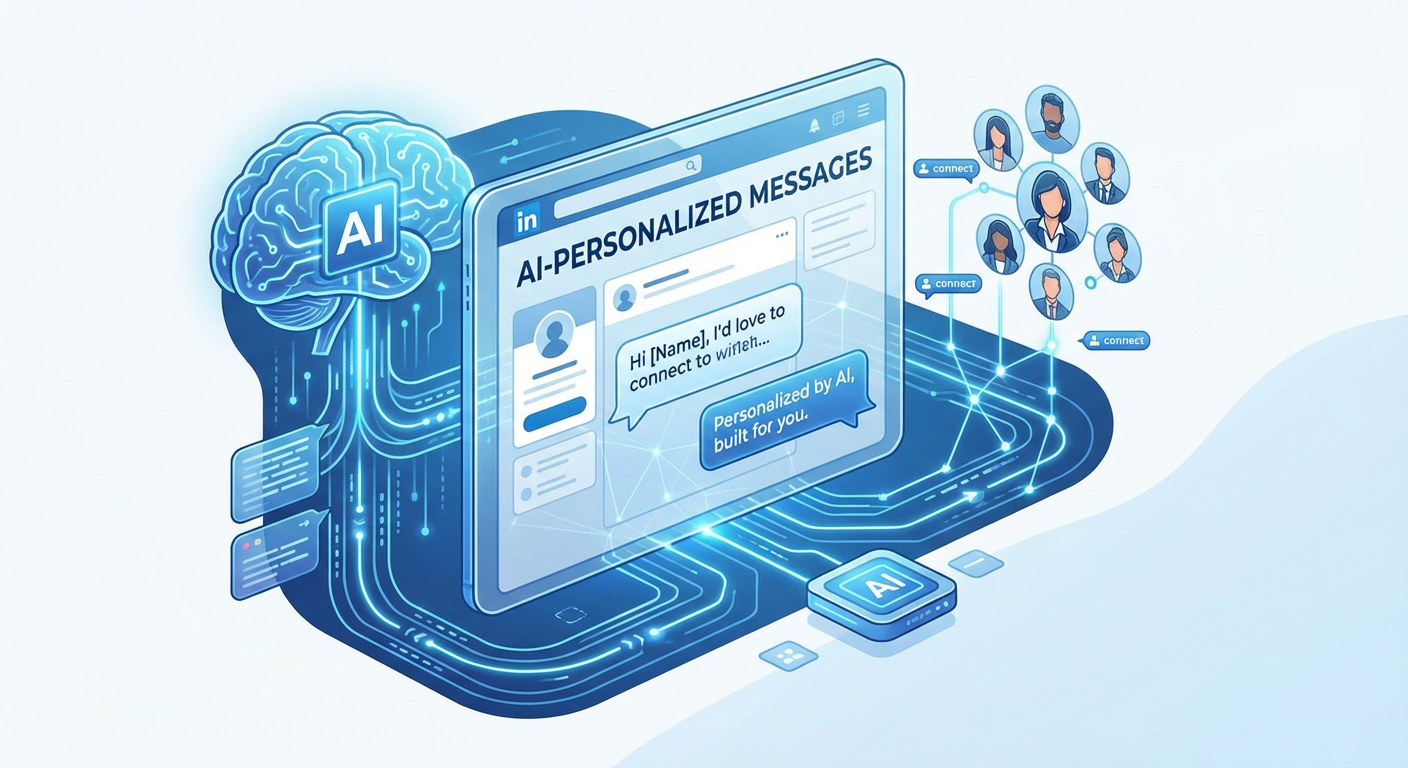
AI-powered LinkedIn outreach tools don't just fill in name fields—they analyze vast amounts of data to understand who your prospects really are. Modern AI systems examine profile information, recent posts, engagement patterns, shared connections, company news, and industry trends to build comprehensive prospect profiles.
Here's what sets AI apart: it identifies contextual hooks that humans might miss. Did your prospect recently change jobs? AI catches that. Did they comment on a post about marketing automation three days ago? AI notes that interest. Did their company just announce a funding round? AI recognizes the opportunity.
Tools like Crystal, Lavender, and Humantic AI use personality assessment algorithms to predict communication preferences. Some prospects prefer data-driven messages with statistics and ROI calculations. Others respond better to storytelling and relationship-building. AI helps you match your message style to each recipient's preferences, dramatically improving response rates.
According to a 2025 report by McKinsey, AI-personalized outreach generates 3.5x higher response rates compared to traditional methods, with some companies reporting engagement increases of up to 250%.
The Components of a High-Converting AI-Crafted Message
AI doesn't just throw random personal details into templates. Sophisticated systems understand message architecture—the specific elements that drive opens, responses, and conversions. Let's break down what makes these messages work.
Compelling Subject Lines: AI analyzes millions of successful messages to identify patterns in subject lines that get opened. It tests variables like length, personalization level, curiosity gaps, and relevance. The best AI tools generate multiple subject line options and predict which will perform best for specific prospect segments.
Relevant Openers: The first sentence determines whether someone keeps reading or hits delete. AI crafts openers that reference specific, recent, and relevant information about the prospect. Instead of "I noticed we're in the same industry," you get "Congratulations on TechCorp's expansion into the healthcare vertical—I saw the announcement last week."
Value-First Body Content: AI structures the message body around the prospect's likely pain points and goals. It doesn't lead with what you're selling; it leads with how you can help solve their specific challenges. The best AI systems create messages that feel like they come from someone who truly understands the recipient's situation.
Natural Call-to-Action: AI knows that "Let's schedule a call" often falls flat. Instead, it suggests low-friction CTAs tailored to the relationship stage: "Would a 3-minute chat about your current lead gen process be valuable?" or "I put together a quick resource on this—mind if I share it?"
Best AI-Powered Tools for LinkedIn Message Personalization
The AI outreach landscape has exploded in recent years. Here are the tools marketing professionals are using to transform their LinkedIn results in 2025:
Lavender: This AI writing assistant analyzes your draft messages and scores them for effectiveness. It provides real-time suggestions for personalization, tone adjustment, and structure improvement. Lavender integrates with LinkedIn and major CRM platforms, learning from your successful messages to improve recommendations over time.
Amplemarket: Combining AI-powered prospecting with personalized outreach, Amplemarket researches prospects, identifies relevant talking points, and generates customized messages. Users report average response rates of 15-20%, significantly above industry benchmarks.
Reply.io: This platform uses AI to create multi-touch sequences across LinkedIn and email. Its AI analyzes prospect behavior to determine optimal timing, channel, and message content for each touchpoint. The system learns from engagement patterns to continuously refine its approach.
Humanlinker: Specializing in hyper-personalization, Humanlinker's AI scans prospect digital footprints across multiple platforms, generating unique icebreakers and conversation starters. It's particularly effective for high-value enterprise outreach where deep personalization matters most.
PhantomBuster + ChatGPT Integration: For teams wanting more control, combining PhantomBuster's LinkedIn automation with ChatGPT's language capabilities creates powerful custom workflows. This approach requires more technical setup but offers maximum flexibility.
Real-World Success Stories: AI Outreach in Action
Let's look at how real companies are using AI to revolutionize their LinkedIn outreach:
Case Study 1: SaaS Startup Triples Qualified Meetings: A B2B SaaS company serving HR departments implemented AI-powered LinkedIn outreach targeting HR directors at mid-sized companies. By using AI to reference specific company hiring announcements and industry challenges, they increased their response rate from 6% to 18% and tripled qualified sales meetings within 60 days.
Case Study 2: Marketing Agency Reduces Outreach Time by 70%: A digital marketing agency previously spent 10+ hours weekly on LinkedIn prospecting. After implementing AI tools, they reduced this to 3 hours while simultaneously increasing their outreach volume by 400%. Their conversion rate from connection to consultation doubled from 3% to 6%.
Case Study 3: Enterprise Software Company Personalizes at Scale: An enterprise software provider needed to reach C-suite executives at Fortune 1000 companies—a notoriously difficult audience. Using AI to analyze executive content, speaking engagements, and company initiatives, they crafted messages referencing specific strategic priorities. Their meeting booking rate increased from 2% to 8%, generating $2.3M in pipeline within one quarter.
These examples share common threads: they used AI not to replace human judgment but to enhance it, they focused on genuine value delivery rather than just personalization gimmicks, and they continuously refined their approach based on data.
The Ethics of AI-Powered Outreach: Where to Draw the Line
With great power comes great responsibility. AI makes it possible to reach thousands of people with personalized messages, but that doesn't mean you should. Here are the ethical boundaries smart marketers respect:
Transparency Matters: While you don't need to lead every message with "This was generated by AI," you should ensure your outreach remains genuinely helpful and honest. AI should enhance your authentic voice, not replace it with synthetic personality.
Respect Privacy Boundaries: Just because AI can find information doesn't mean you should use all of it. References to public professional information are fair game; creepy stalker-level details cross the line.
Avoid Manipulation: AI can predict psychological triggers and optimize for responses. Use this capability to better serve prospects, not to manipulate them into conversations they don't want.
Honor Opt-Outs: If someone says they're not interested, respect that immediately. AI shouldn't be used to find new angles to re-approach people who've declined.
Maintain Quality Control: Review AI-generated messages before sending. AI makes mistakes, and you're ultimately responsible for what goes out under your name.
According to a 2025 survey by the DMA (Data & Marketing Association), 73% of consumers don't mind AI-personalized outreach if it's relevant and valuable, but 68% express concern about manipulation and privacy invasion. The line between helpful and creepy is thin—stay on the right side of it.
Implementing AI Outreach: A Step-by-Step Roadmap
Ready to transform your LinkedIn outreach with AI? Here's your implementation roadmap:
Step 1: Define Your Ideal Customer Profile (ICP): AI works best when it knows who you're targeting. Document detailed ICPs including job titles, company sizes, industries, pain points, and behavioral indicators. The more specific your ICP, the better AI can personalize.
Step 2: Choose Your Tools: Based on your budget, technical capabilities, and use case, select AI tools that fit your needs. Many offer free trials—test multiple options before committing. Consider integration with your existing CRM and sales stack.
Step 3: Develop Message Frameworks: AI needs good inputs to generate good outputs. Create message frameworks that capture your value proposition, brand voice, and key differentiators. Think of these as guidelines for AI to work within, not rigid templates.
Step 4: Train Your AI: Most advanced AI tools learn from your feedback. Consistently rate generated messages, make edits, and provide input. Over time, the AI adapts to your preferences and improves its output quality.
Step 5: Test and Iterate: Start small. Run A/B tests comparing AI-personalized messages against your traditional approach. Track metrics like connection acceptance rate, response rate, and conversion to meetings. Use data to refine your strategy.
Step 6: Scale Strategically: Once you've validated your approach, gradually increase volume. Monitor quality as you scale—more messages shouldn't mean worse messages. Maintain the balance between efficiency and effectiveness.
Step 7: Integrate with Broader Strategy: AI LinkedIn outreach works best as part of a multi-channel strategy. Connect it with your email campaigns, content marketing, and sales processes for comprehensive prospect engagement.
Measuring Success: Metrics That Matter
How do you know if your AI-powered LinkedIn outreach is actually working? Track these key metrics:
Connection Acceptance Rate: The percentage of connection requests accepted. Benchmark: 30-50% is healthy; below 20% suggests poor targeting or messaging.
Response Rate: The percentage of messages that receive replies. Benchmark: 15-25% for well-targeted AI-personalized outreach; below 10% needs improvement.
Conversation-to-Meeting Conversion: The percentage of message conversations that result in scheduled meetings. Benchmark: 20-30% for qualified prospects.
Cost Per Meeting: Calculate the total cost of your AI tools and time investment divided by meetings generated. Compare this to other channels to evaluate ROI.
Message-to-Pipeline: Track how LinkedIn conversations convert to sales pipeline. This is your ultimate success metric—everything else is a leading indicator.
Use LinkedIn's native analytics alongside your AI tool's reporting to get comprehensive insights. Most AI platforms provide detailed performance dashboards showing what's working and where to optimize.
Common Pitfalls to Avoid
Even with powerful AI tools, marketers make mistakes that tank their results. Here's what to avoid:
Over-Automation: Setting up AI sequences and forgetting about them leads to tone-deaf messages and missed opportunities. AI requires ongoing human oversight.
Generic Personalization: Adding someone's name and company isn't true personalization. AI should reference specific, relevant, recent information that demonstrates genuine interest.
Ignoring Your Profile: If your LinkedIn profile doesn't clearly communicate your value, even perfect messages won't convert. Optimize your profile before ramping up outreach.
Selling Too Soon: The art of the open is about starting conversations, not closing deals. Focus on relationship-building first, value delivery second, and selling third.
Neglecting Follow-Up: Most conversions happen after multiple touchpoints. Design multi-message sequences rather than one-and-done outreach.
Analysis Paralysis: Don't get so caught up in perfecting every variable that you never launch. Start with good-enough, learn from results, and iterate.
The Future of AI-Powered LinkedIn Outreach
Where is this technology headed? Based on current developments and expert predictions, here's what's coming:
Predictive Send Timing: AI will increasingly predict the optimal day and time to message each individual prospect based on their engagement patterns and behavioral data.
Voice and Video Personalization: AI tools are emerging that create personalized video messages at scale, adding a human touch that text alone can't achieve.
Real-Time Conversation AI: Expect AI assistants that help you respond to replies in real-time, suggesting responses based on the conversation context and your goals.
Deeper Integration: AI outreach tools will integrate more seamlessly with CRM, marketing automation, and sales enablement platforms, creating unified prospect engagement systems.
Better Compliance Features: As regulations around AI and data privacy evolve, tools will build in stronger compliance features to help marketers stay on the right side of rules.
The key takeaway: AI will make LinkedIn outreach increasingly sophisticated, but the fundamental principle remains unchanged. Success comes from providing genuine value to real people, not from gaming the system.
Conclusion: Your Next Steps
The art of the open: how AI crafts personalized LinkedIn messages that convert isn't about replacing human connection with algorithms. It's about using technology to scale what great networkers have always done—show genuine interest, provide relevant value, and start meaningful conversations.
You've learned how AI analyzes prospect data to enable true personalization at scale, discovered the specific tools marketing professionals are using to achieve 3-5x better results, and explored the ethical boundaries that separate helpful outreach from spammy noise.
The opportunity is clear: while your competitors continue sending generic messages that get ignored, you can leverage AI to stand out with relevance and value. The tools are available, the technology is proven, and the ROI is measurable.
Here's your next step: Choose one AI outreach tool from this article and commit to a 30-day pilot program. Start small, track your results, and iterate based on data. You'll likely see improved response rates within the first week.
Ready to transform your LinkedIn outreach? Download our free "AI Outreach Implementation Checklist" to guide your rollout, or schedule a consultation to discuss how AI personalization can work for your specific business. The future of networking is personalized, scalable, and AI-powered—and it starts with your next message.