Introduction
In the hyper-competitive world of e-commerce, your product's digital presence is its storefront, salesperson, and packaging all in one. Creating stunning photos, engaging videos, and perfectly optimized listings for thousands of products is a monumental task. It's expensive, time-consuming, and often results in creative bottlenecks. What if you could generate high-quality, conversion-focused content faster and more affordably? This is not a futuristic dream; it's the current reality powered by AI. This article will be your guide to understanding and implementing an AI for E-commerce - Product VIDEO, Photography & Listing Optimizer strategy. We'll explore the tools, benefits, and step-by-step processes to transform your product pages and drive significant growth.
The Challenge: Why Traditional Product Content Falls Short
For years, e-commerce businesses have followed a standard playbook for content creation. This involves organizing expensive photoshoots, hiring videographers, and employing copywriters to craft product descriptions. While effective, this traditional model is fraught with challenges that limit scalability. The cost of a single professional photoshoot can run into thousands of dollars, making it prohibitive for businesses with large and frequently updated inventories. Logistical hurdles, from shipping products to studios to coordinating with models, add layers of complexity and delay your time to market. Furthermore, maintaining a consistent brand aesthetic and voice across thousands of listings is a constant struggle, often leading to a disjointed customer experience.
AI-Powered Product Photography: From Simple to Stunning
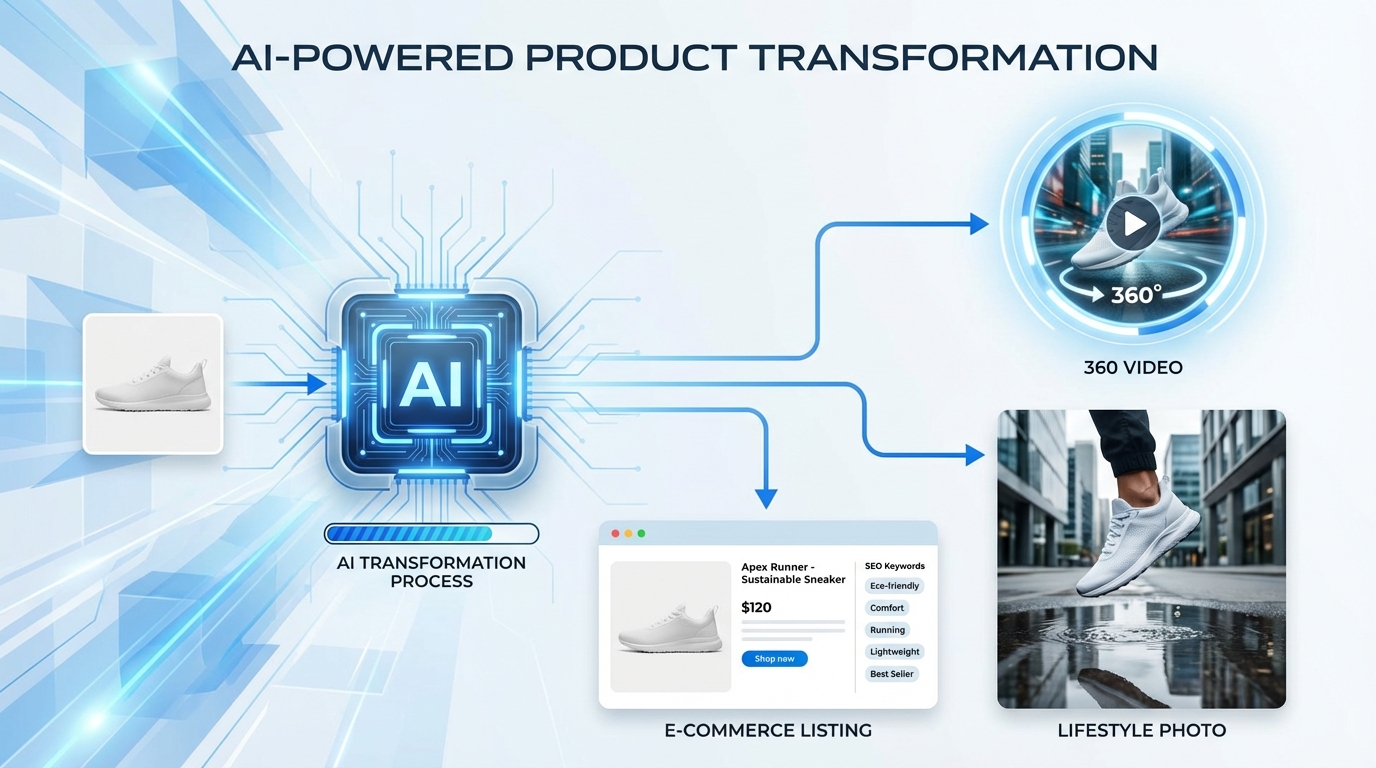
Imagine turning a single, basic product photo taken with a smartphone into a complete gallery of professional-grade images. AI makes this possible. AI-powered photography tools are not just about adding filters; they are about reimagining what’s possible with a single source image. These platforms use generative AI to create context, enhance quality, and produce variety at a fraction of the traditional cost.
Here’s how AI is revolutionizing product photography:
- AI Background Generation: Instantly remove cluttered backgrounds and place your product in any setting imaginable. You can generate clean, white backgrounds for a uniform look or create realistic lifestyle scenes. For example, a picture of a water bottle can be placed on a mountain trail, a yoga mat, or a desk, all without a physical photoshoot.
- AI-Generated Lifestyle Shots: Go beyond simple background replacement. AI can generate entire lifestyle scenes featuring your product. This means you can create compelling images that show your product in use, helping customers visualize it in their own lives. A 2023 study from NielsenIQ found that products with lifestyle imagery see up to a 25% increase in online engagement.
- Image Enhancement and Upscaling: AI algorithms can automatically upscale low-resolution images, correct colors, adjust lighting, and remove imperfections. This ensures every image on your website is crisp, clear, and professional, regardless of the original source quality.
Practical Example: A small jewelry business can use a tool like Booth.AI to upload a simple photo of a necklace on a plain surface. The AI can then generate dozens of images featuring the necklace on different models, against various backdrops, and in diverse lighting conditions, providing a wealth of marketing assets from a single input.
Revolutionizing Product Videos with AI
Video content is a proven conversion driver, but its high production cost has kept it out of reach for many. AI is democratizing video creation, enabling brands to produce engaging product videos, 360-degree views, and even 3D models with unprecedented ease. These tools help bridge the gap between in-person and online shopping by providing a more interactive and comprehensive product view.
Key AI innovations in product video include:
- Video from Still Images: AI can take a series of static product images and animate them to create dynamic, engaging video clips or slideshows, complete with music and text overlays.
- AI-Generated 360° Views and 3D Models: Tools like Luma AI can create immersive 3D models and 360° spins from a short video clip taken with your phone. This allows customers to inspect a product from every angle, significantly increasing purchase confidence and reducing return rates. According to Shopify, product pages with 3D models have a 94% higher conversion rate on average.
- AI Avatars and Voiceovers: You can create instructional or promotional videos featuring AI-generated human-like avatars. Simply provide a script, and the AI will generate a video with a natural-sounding voiceover in multiple languages, making global marketing campaigns incredibly efficient.
The Smartest A/B Test: AI for Listing Optimization
Your product photos and videos can attract a shopper, but it's the listing copy—the title, description, and bullet points—that closes the deal and ensures you get found on search engines. An AI for E-commerce - Product VIDEO, Photography & Listing Optimizer strategy isn't complete without optimizing the text. AI-powered text generation and optimization tools act like a team of expert copywriters and SEO specialists working for you 24/7.
Here’s how AI can supercharge your listings:
- SEO Keyword Identification: AI tools analyze millions of data points from search engines and competitor sites to identify the most relevant and high-converting keywords for your product. This ensures your listings rank higher and attract qualified traffic.
- Compelling Copywriting: Natural Language Processing (NLP) models, like the technology behind ChatGPT, can write persuasive, on-brand product descriptions, catchy titles, and benefit-driven bullet points. You can provide a few key features, and the AI will craft compelling narratives that resonate with your target audience.
- Automated A/B Testing: AI can generate multiple variations of a product title or description and even help you run A/B tests to determine which version leads to the highest conversion rate, taking the guesswork out of optimization.
Internal Link Suggestion: To learn more about finding the right keywords, we recommend reading our detailed guide on [Advanced SEO for E-commerce Product Pages].
Getting Started: Your 3-Step AI Implementation Plan
Adopting AI doesn't have to be an overwhelming overhaul of your operations. You can start small and scale strategically. Follow this simple three-step plan to begin integrating AI into your e-commerce workflow.
- Identify Your Biggest Bottleneck: Where is your content creation process the slowest or most expensive? Is it generating high-quality photos? Producing videos? Writing compelling copy? Pinpoint your primary pain point to select the right type of AI tool to trial first.
- Start Small with a Pilot Project: Choose one product category or a new product launch for your first AI project. Select a user-friendly AI tool—many offer free trials or affordable entry-level plans. For example, try using an AI image generator for one new product line and compare the results and costs against a traditional photoshoot.
- Measure, Learn, and Scale: Track key performance indicators (KPIs) for your pilot project. Monitor metrics like conversion rate, add-to-cart rate, time-on-page, and, of course, your return on investment (ROI) from time and cost savings. Use these insights to refine your approach and scale the successful strategies across your entire product catalog.
Potential Risks and How to Mitigate Them
While AI offers immense benefits, it's essential to be aware of the potential risks. A mindful approach can help you avoid common pitfalls. The biggest risk is the loss of your unique brand voice; if used without guidance, AI can produce generic content. To mitigate this, create detailed style guides and brand briefs for your AI tools and always have a human editor review and refine the output. Another concern is an over-reliance on AI, which can sometimes lead to visual or textual content that feels sterile. The best strategy is to use AI for augmentation, not complete automation. Use it to handle the heavy lifting, then add a final human touch to ensure authenticity. Finally, always be mindful of data privacy and use reputable AI platforms that are transparent about their data usage and image rights.
Conclusion
We are at a turning point in e-commerce. The manual, time-intensive methods of content creation are quickly being replaced by faster, smarter, and more cost-effective AI-driven solutions. By leveraging an AI for E-commerce - Product VIDEO, Photography & Listing Optimizer strategy, you can create superior product experiences that not only look professional but are also engineered to convert. From generating endless lifestyle photos from a single image to crafting SEO-perfected descriptions in seconds, AI empowers you to scale your business like never before. The question is no longer if you should adopt AI, but how quickly you can integrate it.
Ready to transform your product listings and leap ahead of the competition? Subscribe to our newsletter for exclusive insights and receive a free checklist: "How to Choose the Right AI Tools for Your E-commerce Business."